Sally looked around the table for anyone who wasn't trying to talk. To her relief, most weren't, but the usual suspects had their megaphones on, blasting each other at full volume. "Hold on, everyone. Hold on!" she said, raising her voice way past the comfort level. Greg — no surprise — was the last to stop.
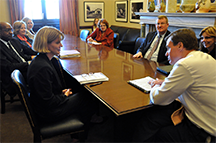
Senator Mark Warner (Democrat of Virginia) meets with mayors regarding the consequences of federal budget cuts in 2011. Photo courtesy Senator Mark Warner (CC by 2.0).
In a more normal tone, Sally continued: "If we're going to discuss this, we'll have some order in this room. I want only one person talking at a time. Clear?"
In her attempt to bring order to chaos, Sally has just intervened, but she's unlikely to be successful unless she can enroll the entire group in the effort.
Chaotic, interrupt-driven discussions are expensive. Here are some of the costs that we can avoid with more orderly exchanges:
- Delays and confusion
- When we interrupt people, we sometimes prevent them from making their points in the way they planned. This introduces delays and confusion, if they ever actually make their points.
- Lost contributions
- Often we put the
responsibility for order
(or disorder) in a meeting
on the shoulders of
the meeting chair,
but everyone in
the room plays a role - Some people are especially sensitive to interruption. Some hold back, for fear of interrupting someone. Others are intimidated by the prospect of being interrupted. In an atmosphere of interruption, the group loses access to much of its creativity.
- Erosion of self-esteem
- When some people are interrupted, they can feel devalued. The interruption can be painful and humiliating, and it can move them to anger, even if they don't express it in the meeting. These effects can extend beyond that meeting and beyond that team.
Often we put the responsibility for order (or disorder) on the shoulders of the meeting chair, but everyone in the room plays a role. Even those who sit quietly have the choice of objecting to the disorder. Here are some tips for maintaining order.
- Prevention is easier than repair
- It's much easier to create an environment in which people resist the temptation to interrupt than it is to deal with interrupters.
- Establish norms
- Have a discussion of group norms. One possible norm: we will not interrupt each other. Post the norms on the wall. Review them at the beginning of each meeting.
- Create mechanisms for necessary interruptions
- Certain interruptions are helpful. Examples are requests for information, requests to make critical corrections, and requests to modify the group process. Establish key phrases that team members can use to make these requests.
- For especially tense topics, get a facilitator
- A facilitator who isn't part of the team is more likely to be objective than any team member is. A skilled facilitator knows how to maintain a "queue" of people who want to comment, and provides the trust required to encourage everyone to wait patiently. Executive teams: hire a facilitator from outside the organization.
If you have a serious problem with interruptions, chances are good that you no longer notice. Track interruptions over time. What's the trend? Is there a pattern? Can you do better?  Top
Top  Next Issue
Do you spend your days scurrying from meeting to meeting? Do you ever wonder if all these meetings are really necessary? (They aren't) Or whether there isn't some better way to get this work done? (There is) Read 101 Tips for Effective Meetings to learn how to make meetings much more productive and less stressful — and a lot more rare. Order Now!
For an exploration of interruptions from the point of view of the one being interrupted, check out "Let Me Finish, Please," Point Lookout for January 22, 2003.
Reader Comments
- Mary Pope
- We had this problem once and instituted a talking stick. You had to have the stick in order to speak. Only when you relinquished it could the next person have the floor. It slowed the meeting a bit but was worth it. An unexpected side effect was that it added some levity to the meeting of a contentious group of people. Plus it made everyone feel like they had the floor and everyone's undivided attention. Better yet, after a few meetings with the talking stick it was no longer necessary and gradually fell from use.
Your comments are welcome
Would you like to see your comments posted here? rbrendPtoGuFOkTSMQOzxner@ChacEgGqaylUnkmwIkkwoCanyon.comSend me your comments by email, or by Web form.
About Point Lookout
 Thank you for reading this article. I hope you enjoyed it and
found it useful, and that you'll consider recommending it to a friend.
Thank you for reading this article. I hope you enjoyed it and
found it useful, and that you'll consider recommending it to a friend.
This article in its entirety was written by a human being. No machine intelligence was involved in any way.
Point Lookout is a free weekly email newsletter. Browse the archive of past issues. Subscribe for free.
Support Point Lookout by joining the Friends of Point Lookout, as an individual or as an organization.
Do you face a complex interpersonal situation? Send it in, anonymously if you like, and I'll give you my two cents.
Related articles
More articles on Personal, Team, and Organizational Effectiveness:
 Mastering Meeting Madness
- If you lead an organization, and people are mired in meeting madness, you can end it. Here are a few
tips that can free everyone to finally get some work done.
 Mudfights
- When we steer the discussion away from issues to attack the credibility, motives, or character of our
debate partners, we often resort to a technique known as the ad hominem attack. It's unfair, it's unethical,
and it leads to bad, expensive decisions that we'll probably regret.
 Wacky Words of Wisdom: IV
- Words of wisdom are pithy sayings that can be valuable so often that we believe them absolutely. Although
these sayings are often valuable, they aren't universally valid. Here's Part IV of a growing collection.
 Anticipating Absence: Passings
- In times more normal than ours, co-workers who pass on tend to do so one at a time. Disease or accidents
rarely strike many co-workers in the same week, month, or year. There are exceptions — 9/11 was
one such. This pandemic is another.
 Virtual Interviews: II
- The pandemic has made face-to-face job interviews less important. And so we must now also master virtual
interviews, and that requires understanding the effects of the attendance list, video presence, and
the technologies of staging, lighting, and makeup.
See also Personal, Team, and Organizational Effectiveness, Effective Meetings and Effective Communication at Work for more related articles.
Forthcoming issues of Point Lookout
 Coming April 24: Antipatterns for Time-Constrained Communication: 1
- Knowing how to recognize just a few patterns that can lead to miscommunication can be helpful in reducing the incidence of problems. Here is Part 1 of a collection of communication antipatterns that arise in technical communication under time pressure. Available here and by RSS on April 24.
 And on May 1: Antipatterns for Time-Constrained Communication: 2
- Recognizing just a few patterns that can lead to miscommunication can reduce the incidence of problems. Here is Part 2 of a collection of antipatterns that arise in technical communication under time pressure, emphasizing those that depend on content. Available here and by RSS on May 1.
Coaching services
I offer email and telephone coaching at both corporate and individual rates. Contact Rick for details at rbrendPtoGuFOkTSMQOzxner@ChacEgGqaylUnkmwIkkwoCanyon.com or (650) 787-6475, or toll-free in the continental US at (866) 378-5470.
Get the ebook!
Past issues of Point Lookout are available in six ebooks:
- Get 2001-2 in Geese Don't Land on Twigs (PDF, )
- Get 2003-4 in Why Dogs Wag (PDF, )
- Get 2005-6 in Loopy Things We Do (PDF, )
- Get 2007-8 in Things We Believe That Maybe Aren't So True (PDF, )
- Get 2009-10 in The Questions Not Asked (PDF, )
- Get all of the first twelve years (2001-2012) in The Collected Issues of Point Lookout (PDF, )
Are you a writer, editor or publisher on deadline? Are you looking for an article that will get people talking and get compliments flying your way? You can have 500-1000 words in your inbox in one hour. License any article from this Web site. More info
Follow Rick


Recommend this issue to a friend
Send an email message to a friend
rbrendPtoGuFOkTSMQOzxner@ChacEgGqaylUnkmwIkkwoCanyon.comSend a message to Rick
A Tip A Day feed
Point Lookout weekly feed
 My blog, Technical Debt for Policymakers, offers
resources, insights, and conversations of interest to policymakers who are concerned with managing
technical debt within their organizations. Get the millstone of technical debt off the neck of your
organization!
My blog, Technical Debt for Policymakers, offers
resources, insights, and conversations of interest to policymakers who are concerned with managing
technical debt within their organizations. Get the millstone of technical debt off the neck of your
organization! Learn how to make meetings more productive — and more rare.Fed up with tense, explosive meetings? Are you the target of a bully? Learn how to make peace with conflict.Are your project teams plagued by turnover, burnout, and high defect rates? Turn your culture around.Save a bundle and even more important save time! Order the Combo Package and download all ebooks
and tips books at once.
Learn how to make meetings more productive — and more rare.Fed up with tense, explosive meetings? Are you the target of a bully? Learn how to make peace with conflict.Are your project teams plagued by turnover, burnout, and high defect rates? Turn your culture around.Save a bundle and even more important save time! Order the Combo Package and download all ebooks
and tips books at once.