Many of us have trouble associating names and faces, especially when we're meeting lots of new people at once. Conferences, visits to remote sites, new jobs and assuming responsibility for new organizations are situations likely to surface this problem.
 One helpful technique for remembering names is the mnemonic. A mnemonic is a device for associating two concepts. For those who have difficulty remembering what a mnemonic is, here's a mnemonic for "mnemonic:" Memorization's Not Easy; Memory Often Needs Initial Cues.
As another example, how do you remember which way to change the clock when going on or off Daylight Savings Time? Many of us use the mnemonic "Spring Forward, Fall Back." Of course, this doesn't work for Australians. They do change the clock the same way for the same seasons, but Australians call Fall Autumn, and "Spring forward, Autumn back" just doesn't work.
To remember the name of someone you're meeting for the first time, anchor the name using the RUMM method: Repeat, Use, and Make a Mnemonic.
To remember the nameof someone you just met,
repeat it, use it, and
make a mnemonic
- Repeat
- Respond to the name with "Hello, Bill" (taking care to substitute the person's actual name for "Bill").
- Use
- Say something to the person immediately, using the name you just learned: "Bill, you're working on Metronome, as I recall. Was that your team that saved our necks last month?"
- Make a Mnemonic
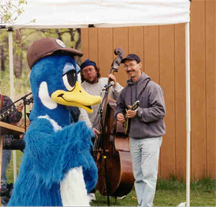
- Create a visual or auditory image that connects the person's face to the name. Imagine Bill, for example, in a Donald Duck outfit, complete with yellow bill.
Here are some other techniques that will help people in your organization remember each other's names better.
- Create an intranet album
- Create a photo album for your department and post it on your company's intranet. If you aren't in a position to create a department photo album, create a personal Web site and put your own photo there. If you can't do that, tack a photo of yourself on your door. See "Make a Project Family Album," Point Lookout for May 2, 2001.
- Use the names of people you know
- Too many of us avoid using names, even when we're sure of them. Make a point of using the names of people you know. If we all did this, we'd have a better chance of overhearing the names of people we're less sure of.
- Practice recovering from mistakes
- Fear of using the wrong name, or mispronouncing the right one, are two reasons why we don't use people's names. Look upon uncertainty as an opportunity to practice recovering from mistakes, and to graciously ask forgiveness. See "Demanding Forgiveness," Point Lookout for June 18, 2003.
- Introduce yourself
- When you meet someone you don't recognize, introduce yourself. Sometimes we avoid this kind of introduction out of fear that we've met before. See "Practice mistakes" above.
Some of us never forget a face. Some never forget a name. Remembering either one doesn't do much good unless you can connect one to the other.  Top
Top  Next Issue
The article you've been reading is an archived issue of Point Lookout, my weekly newsletter. I've been publishing it since January, 2001, free to all subscribers, over the Web, and via RSS. You can help keep it free by donating either as an individual or as an organization. You'll receive in return my sincere thanks — and the comfort of knowing that you've helped to propagate insights and perspectives that can help make our workplaces a little more human-friendly. More
Reader Comments
- Anonymous
- Thanks for the weekly Point Lookout — it always provides an insightful and interesting read.
- Your story of the forgotten names reminded me of a trick used by a friend of mine. He asks "How do you pronounce your family name?" This usually works, especially in Asia (I'm based in Beijing) but recently when he asked the question he received a puzzled look and the reply "I pronounce my family name as Smith."
- Regards.
Your comments are welcome
Would you like to see your comments posted here? rbrendPtoGuFOkTSMQOzxner@ChacEgGqaylUnkmwIkkwoCanyon.comSend me your comments by email, or by Web form.
About Point Lookout
 Thank you for reading this article. I hope you enjoyed it and
found it useful, and that you'll consider recommending it to a friend.
Thank you for reading this article. I hope you enjoyed it and
found it useful, and that you'll consider recommending it to a friend.
This article in its entirety was written by a human being. No machine intelligence was involved in any way.
Point Lookout is a free weekly email newsletter. Browse the archive of past issues. Subscribe for free.
Support Point Lookout by joining the Friends of Point Lookout, as an individual or as an organization.
Do you face a complex interpersonal situation? Send it in, anonymously if you like, and I'll give you my two cents.
Related articles
More articles on Personal, Team, and Organizational Effectiveness:
 Virtual Communications: II
- Participating in or managing a virtual team presents special communications challenges. Here's Part
II of some guidelines for communicating with members of virtual teams.
 Four Popular Ways to Mismanage Layoffs: I
- When layoffs are necessary, the problems they are meant to address are sometimes exacerbated by mismanagement
of the layoff itself. Here is Part I of a discussion of four common patterns of mismanagement, and some
suggestions for those managers and other employees who recognize the patterns in their own companies.
 Discussion Distractions: I
- Meetings could be far more productive, if only we could learn to recognize and prevent the distractions
that lead us off topic and into the woods. Here is Part I of a small catalog of distractions frequently
seen in meetings.
 Teamwork Myths: Formation
- Much of the conventional wisdom about teams is in the form of over-generalized rules of thumb, or myths.
In this first part of our survey of teamwork myths, we examine two myths about forming teams.
 Cooperations That Need to Be Collaborations
- Modern products and services are so complex that many people cooperate and collaborate to produce them.
When people are cooperating but the work actually requires collaborating, risks arise that can threaten
the success of the effort.
See also Personal, Team, and Organizational Effectiveness for more related articles.
Forthcoming issues of Point Lookout
 Coming May 1: Antipatterns for Time-Constrained Communication: 2
- Recognizing just a few patterns that can lead to miscommunication can reduce the incidence of miscommunications. Here's Part 2 of a collection of antipatterns that arise in communication under time pressure, emphasizing those that depend on content. Available here and by RSS on May 1.
- And on May 8: Antipatterns for Time-Constrained Communication: 3
- Recognizing just a few patterns that can lead to miscommunication can reduce the incidence of problems. Here is Part 3 of a collection of antipatterns that arise in technical communication under time pressure, emphasizing past experiences of participants. Available here and by RSS on May 8.
Coaching services
I offer email and telephone coaching at both corporate and individual rates. Contact Rick for details at rbrendPtoGuFOkTSMQOzxner@ChacEgGqaylUnkmwIkkwoCanyon.com or (650) 787-6475, or toll-free in the continental US at (866) 378-5470.
Get the ebook!
Past issues of Point Lookout are available in six ebooks:
- Get 2001-2 in Geese Don't Land on Twigs (PDF, )
- Get 2003-4 in Why Dogs Wag (PDF, )
- Get 2005-6 in Loopy Things We Do (PDF, )
- Get 2007-8 in Things We Believe That Maybe Aren't So True (PDF, )
- Get 2009-10 in The Questions Not Asked (PDF, )
- Get all of the first twelve years (2001-2012) in The Collected Issues of Point Lookout (PDF, )
Are you a writer, editor or publisher on deadline? Are you looking for an article that will get people talking and get compliments flying your way? You can have 500-1000 words in your inbox in one hour. License any article from this Web site. More info
Follow Rick


Recommend this issue to a friend
Send an email message to a friend
rbrendPtoGuFOkTSMQOzxner@ChacEgGqaylUnkmwIkkwoCanyon.comSend a message to Rick
A Tip A Day feed
Point Lookout weekly feed
 My blog, Technical Debt for Policymakers, offers
resources, insights, and conversations of interest to policymakers who are concerned with managing
technical debt within their organizations. Get the millstone of technical debt off the neck of your
organization!
My blog, Technical Debt for Policymakers, offers
resources, insights, and conversations of interest to policymakers who are concerned with managing
technical debt within their organizations. Get the millstone of technical debt off the neck of your
organization! Are your project teams plagued by turnover, burnout, and high defect rates? Turn your culture around.Bad boss, long commute, troubling ethical questions, hateful colleague? Learn what we can do when we
love the work but not the job.Learn how to make meetings more productive — and more rare.Is every other day a tense, anxious, angry misery as you watch people around you, who couldn't even
think their way through a game of Jacks, win at workplace politics and steal the credit and glory
for just about everyone's best work including yours? Read 303 Secrets of Workplace Politics!Save a bundle and even more important save time! Order the Combo Package and download all ebooks
and tips books at once.
Are your project teams plagued by turnover, burnout, and high defect rates? Turn your culture around.Bad boss, long commute, troubling ethical questions, hateful colleague? Learn what we can do when we
love the work but not the job.Learn how to make meetings more productive — and more rare.Is every other day a tense, anxious, angry misery as you watch people around you, who couldn't even
think their way through a game of Jacks, win at workplace politics and steal the credit and glory
for just about everyone's best work including yours? Read 303 Secrets of Workplace Politics!Save a bundle and even more important save time! Order the Combo Package and download all ebooks
and tips books at once.