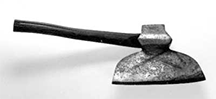
Beatty Pennsylvania broad ax. The broad axe (also called hewing axe or side axe) was the preferred tool for squaring timber or flattening the sides of logs. This was an essential step in preparing material for log buildings and timber framing for houses or barns. Later applications were for railroad ties and trestle bridges. The blade is as broad as a headsman's axe, though the handle is shorter. Photo courtesy U.S. Federal Highway Administration.
Lenore and Brad stepped through the revolving door and out into the sunshine of the plaza. Lenore had intended to wait until they got to the car, but nobody was around, so she took a risk. "Here's a tip, since you're new," she began. "It's just not safe to talk that way in these meetings."
Brad was listening. "I figured," he said. "Warner's reaching for his double-bladed axe was the tip-off."
"Uh-huh," Lenore agreed, "and you haven't even seen real trouble yet."
Lenore is educating Brad in survival strategies for the organization he has just joined. Hopefully, it isn't too late, but if he had known what to look for, he might have been a little more cautious. Here are ten attributes that suggest that your work culture might be a blaming culture.
- Blame runs downhill in public, and uphill at the water-cooler
- Lessons-learned panels rarely assign any responsibility to the owner of the panel or to any superiors. Blame almost always runs downhill. But water-cooler talk is the opposite — people grumble about management.
- We rarely blame processes
- In a blaming culture,
if something goes wrong,
it's always the fault
of some one person - Blame is rarely assigned to equipment, to a process, or to a situation. If something went wrong, human error is the cause.
- We usually blame an individual
- Rarely do we assign blame to a group or to several people. One is enough to satisfy the beast.
- We kill messengers
- Bearers of bad news are especially at risk, because we have a pattern of killing the messenger.
- CYA is a standard business procedure
- Since you can't be sure when you might need cover, it's only prudent to take every opportunity to cover your behind.
- In response to catastrophe, we apply revised policy retroactively
- When something bad happens, we convene a panel to write or revise policies and procedures. Then we apply them retroactively, and we blame violators.
- We never revise policy in response to success
- When something good happens, we feel that our policies and procedures are validated, so there's nothing to do.
- We have designated winners
- When good things happen, we usually assign credit to someone who's already an anointed winner. Heroes are rarely found in the trenches.
- We blame people for breaking unwritten rules
- Some policies and rules are written down only in obscure documents, if they're written at all. No matter. You can still be blamed for violating them.
- People get sandbagged
- Some people find out about a failure or policy violation for the very first time in their annual reviews. This is especially maddening when having withheld the information prevented the employee from righting a wrong, or from avoiding repetitions.
If you find yourself being blamed, remember that blame is almost always inappropriate. Blaming yourself then only adds to your trouble. Learning is a far better choice.  Top
Top  Next Issue
Is every other day a tense, anxious, angry misery as you watch people around you, who couldn't even think their way through a game of Jacks, win at workplace politics and steal the credit and glory for just about everyone's best work including yours? Read 303 Secrets of Workplace Politics, filled with tips and techniques for succeeding in workplace politics. More info
The words blame and accountability are often used interchangeably, but they have very different meanings. See "Is It Blame or Is It Accountability?," Point Lookout for December 21, 2005, for a discussion of blame and accountability. For the effects of blame on the investigations of unwanted outcomes, see "Obstacles to Finding the Reasons Why," Point Lookout for April 4, 2012. For more on blaming and blaming organizations, see "Organizational Coping Patterns" and "Plenty of Blame to Go Around," Point Lookout for August 27, 2003.
Your comments are welcome
Would you like to see your comments posted here? rbrendPtoGuFOkTSMQOzxner@ChacEgGqaylUnkmwIkkwoCanyon.comSend me your comments by email, or by Web form.About Point Lookout
 Thank you for reading this article. I hope you enjoyed it and
found it useful, and that you'll consider recommending it to a friend.
Thank you for reading this article. I hope you enjoyed it and
found it useful, and that you'll consider recommending it to a friend.
This article in its entirety was written by a human being. No machine intelligence was involved in any way.
Point Lookout is a free weekly email newsletter. Browse the archive of past issues. Subscribe for free.
Support Point Lookout by joining the Friends of Point Lookout, as an individual or as an organization.
Do you face a complex interpersonal situation? Send it in, anonymously if you like, and I'll give you my two cents.
Related articles
More articles on Workplace Politics:
 How to Stop Being Overworked: II
- Although many of us are overloaded as a result of our own choices, some are overloaded by abusive supervisors.
If you find yourself in that situation, what can you do?
 Deep Trouble and Getting Deeper
- Here's a catalog of actions people take when the projects they're leading are in deep trouble, and they're
pretty sure there's no way out.
 Bottlenecks: I
- Some people take on so much work that they become "bottlenecks." The people around them repeatedly
find themselves stuck, awaiting responses or decisions. Why does this happen and what are the costs?
 That Was a Yes-or-No Question: II
- When, in the presence of others, someone asks you "a simple yes or no" question, beware. Chances
are that you're confronting a trap. Here's Part II of a set of suggestions for dealing with the yes-or-no
trap.
 When Your Boss Leaves Before You Do
- At some point in your career, your supervisor will leave his or her position and you'll end up reporting
to someone else. It can be a harrowing experience, even if you prepare. Nevertheless, preparation usually
produces a better outcome than winging it.
See also Workplace Politics, Conflict Management and Managing Your Boss for more related articles.
Forthcoming issues of Point Lookout
 Coming May 1: Antipatterns for Time-Constrained Communication: 2
- Recognizing just a few patterns that can lead to miscommunication can reduce the incidence of miscommunications. Here's Part 2 of a collection of antipatterns that arise in communication under time pressure, emphasizing those that depend on content. Available here and by RSS on May 1.
- And on May 8: Antipatterns for Time-Constrained Communication: 3
- Recognizing just a few patterns that can lead to miscommunication can reduce the incidence of problems. Here is Part 3 of a collection of antipatterns that arise in technical communication under time pressure, emphasizing past experiences of participants. Available here and by RSS on May 8.
Coaching services
I offer email and telephone coaching at both corporate and individual rates. Contact Rick for details at rbrendPtoGuFOkTSMQOzxner@ChacEgGqaylUnkmwIkkwoCanyon.com or (650) 787-6475, or toll-free in the continental US at (866) 378-5470.
Get the ebook!
Past issues of Point Lookout are available in six ebooks:
- Get 2001-2 in Geese Don't Land on Twigs (PDF, )
- Get 2003-4 in Why Dogs Wag (PDF, )
- Get 2005-6 in Loopy Things We Do (PDF, )
- Get 2007-8 in Things We Believe That Maybe Aren't So True (PDF, )
- Get 2009-10 in The Questions Not Asked (PDF, )
- Get all of the first twelve years (2001-2012) in The Collected Issues of Point Lookout (PDF, )
Are you a writer, editor or publisher on deadline? Are you looking for an article that will get people talking and get compliments flying your way? You can have 500-1000 words in your inbox in one hour. License any article from this Web site. More info
Follow Rick


Recommend this issue to a friend
Send an email message to a friend
rbrendPtoGuFOkTSMQOzxner@ChacEgGqaylUnkmwIkkwoCanyon.comSend a message to Rick
A Tip A Day feed
Point Lookout weekly feed
 The message of Point Lookout is unique. Help get the message out. Please donate to help keep Point Lookout available for free to everyone.
 My blog, Technical Debt for Policymakers, offers
resources, insights, and conversations of interest to policymakers who are concerned with managing
technical debt within their organizations. Get the millstone of technical debt off the neck of your
organization!
My blog, Technical Debt for Policymakers, offers
resources, insights, and conversations of interest to policymakers who are concerned with managing
technical debt within their organizations. Get the millstone of technical debt off the neck of your
organization!Beware any resource that speaks of "winning" at workplace politics or "defeating" it. You can benefit or not, but there is no score-keeping, and it isn't a game.
- Wikipedia has a nice article with a list of additional resources
- Some public libraries offer collections. Here's an example from Saskatoon.
- Check my own links collection
- LinkedIn's Office Politics discussion group
 Is every other day a tense, anxious, angry misery as you watch people around you, who couldn't even
think their way through a game of Jacks, win at workplace politics and steal the credit and glory
for just about everyone's best work including yours? Read 303 Secrets of Workplace Politics!Learn how to make your virtual global team sing.A Tip a Day arrives by email, or by RSS Feed, each business day. It's 20 to 30 words at most, and gives
you a new perspective on the hassles and rewards of work life. Most tips also contain links to
related articles. Free!Learn how to make meetings more productive — and more rare.
Is every other day a tense, anxious, angry misery as you watch people around you, who couldn't even
think their way through a game of Jacks, win at workplace politics and steal the credit and glory
for just about everyone's best work including yours? Read 303 Secrets of Workplace Politics!Learn how to make your virtual global team sing.A Tip a Day arrives by email, or by RSS Feed, each business day. It's 20 to 30 words at most, and gives
you a new perspective on the hassles and rewards of work life. Most tips also contain links to
related articles. Free!Learn how to make meetings more productive — and more rare.