When I moved recently, I learned two things. I discovered that if you have a home office, then when you move, you have to move both your home and your office. Maybe I could have figured that out some other way, but the move did create a unique opportunity. As many do, I used the move as motivation to sort through my accumulated junk and keep most of it.
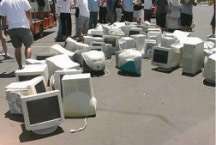
Monitors about to be recycled at an event sponsored by the Nevada Division of Environmental Protection. Photo courtesy NDEP.
That's how I discovered my personal rules for accumulating junk. To get rid of my junk, I've been violating a different rule every day, and I'm getting pretty good at it. You probably have your own rules, but if you don't know what they are, you can use this list as a starting point.
Here are my rules (plus some others) for accumulating junk:
- I might need it someday
- I can't remember why I'm saving this, but it might be important
- I think I can get rid of this, but I'm not 100% sure
- I know I'll use this eventually, when I get the time (or energy)
- I don't need this now, but if I ever do need one, it will either be expensive or impossible to find
- Violate a different rule
every day, and soon
you'll have less junkRemember when we used these? Wow — I bet you can't even get them anymore. - Maybe I can sell this on eBay — oops, the going price is still too low.
- I borrowed this, and I should return it, but I'm so embarrassed that I've had it so long…
- I can't throw this out — maybe it isn't mine
- Hmm, I wonder where the missing parts of this are — maybe I'll find them
- I don't actually know what this is, but I'll keep it until I can figure it out
- Ah, this is that box of stuff I sealed up when I last moved, thinking I would toss it if I didn't open it in a year. Can't remember what's in it. Better not throw it out yet.
- This was a real bargain. Be a shame to get rid of it.
- If I lose X pounds, I know I look good in this
- This is a great book. I should read it. [RecycleBooks.org]
- This was a great book. Maybe I'll read it again.
- This was a great movie (album). I know I'll want to watch it (listen to it) again if I ever get another VCR (turntable).
- Who's that standing next to me in this picture? Better keep it until I can scan it.
- Ah, my first planner — maybe. You never know when you'll need an alibi for 7:30 AM, Tuesday, March 23rd, 1993.
- That computer has sensitive data on it. I better keep it until I can erase it. [GreenDisk, Tech Soup and the Computer Recycling Center]
- Look at that, the postal rates for 1987. Neat-o.
- I wonder how long I have to keep these financial records. Legally, I mean. Better keep 'em. [Women's Institute for a Secure Retirement]
- Another ballpoint pen. Might come in handy sometime.
- Wonder what's on this floppy (Zip disk, removable cartridge, mag tape)? Better keep it for now.
Throwing things away might take some practice. If violating even one of your rules is too hard, start with something easy. Pick up a dead leaf from the ground, and then throw it away immediately. Then work up from there.
After you've made some progress, you might find that offloading junk can create new problems. I now have a slightly used empty bookshelf. Should I fill it or get rid of it?  Top
Top  Next Issue
Love the work but not the job? Bad boss, long commute, troubling ethical questions, hateful colleague? This ebook looks at what we can do to get more out of life at work. It helps you get moving again! Read Go For It! Sometimes It's Easier If You Run, filled with tips and techniques for putting zing into your work life. Order Now!
Your comments are welcome
Would you like to see your comments posted here? rbrendPtoGuFOkTSMQOzxner@ChacEgGqaylUnkmwIkkwoCanyon.comSend me your comments by email, or by Web form.About Point Lookout
 Thank you for reading this article. I hope you enjoyed it and
found it useful, and that you'll consider recommending it to a friend.
Thank you for reading this article. I hope you enjoyed it and
found it useful, and that you'll consider recommending it to a friend.
This article in its entirety was written by a human being. No machine intelligence was involved in any way.
Point Lookout is a free weekly email newsletter. Browse the archive of past issues. Subscribe for free.
Support Point Lookout by joining the Friends of Point Lookout, as an individual or as an organization.
Do you face a complex interpersonal situation? Send it in, anonymously if you like, and I'll give you my two cents.
Related articles
More articles on Personal, Team, and Organizational Effectiveness:
 Tactics for Asking for Volunteers: II
- When we seek volunteers for specific, time-limited tasks, a common approach is just to ask the entire
team at a meeting or teleconference. It's simple, but it carries risks. There are alternatives.
 Discussion Distractions: I
- Meetings could be far more productive, if only we could learn to recognize and prevent the distractions
that lead us off topic and into the woods. Here is Part I of a small catalog of distractions frequently
seen in meetings.
 Take Charge of Your Learning
- Many of us let others set our learning agendas — peers, employers, or the mass media. But you
can gain much both personally and professionally by setting your own learning agenda.
 Contextual Causes of Conflict: I
- When destructive conflict erupts, we usually hold responsible only the people directly involved. But
the choices of others, and general circumstances, can be the real causes of destructive conflict.
 Collaborations That Need to Be Cooperations
- Modern products and services are so complex that many people cooperate and collaborate to produce them.
When people are collaborating but the work actually requires merely cooperating, risks arise that can
threaten the success of the group's efforts.
See also Personal, Team, and Organizational Effectiveness for more related articles.
Forthcoming issues of Point Lookout
 Coming April 17: How to Answer When You Don't Know How to Answer
- People engaged in knowledge work must often respond to questions that test the limits of their knowledge, or the limits of everyone's knowledge. Responding effectively to such questions advances us all. Available here and by RSS on April 17.
 And on April 24: Antipatterns for Time-Constrained Communication: 1
- Knowing how to recognize just a few patterns that can lead to miscommunication can be helpful in reducing the incidence of problems. Here is Part 1 of a collection of communication antipatterns that arise in technical communication under time pressure. Available here and by RSS on April 24.
Coaching services
I offer email and telephone coaching at both corporate and individual rates. Contact Rick for details at rbrendPtoGuFOkTSMQOzxner@ChacEgGqaylUnkmwIkkwoCanyon.com or (650) 787-6475, or toll-free in the continental US at (866) 378-5470.
Get the ebook!
Past issues of Point Lookout are available in six ebooks:
- Get 2001-2 in Geese Don't Land on Twigs (PDF, )
- Get 2003-4 in Why Dogs Wag (PDF, )
- Get 2005-6 in Loopy Things We Do (PDF, )
- Get 2007-8 in Things We Believe That Maybe Aren't So True (PDF, )
- Get 2009-10 in The Questions Not Asked (PDF, )
- Get all of the first twelve years (2001-2012) in The Collected Issues of Point Lookout (PDF, )
Are you a writer, editor or publisher on deadline? Are you looking for an article that will get people talking and get compliments flying your way? You can have 500-1000 words in your inbox in one hour. License any article from this Web site. More info
Follow Rick


Recommend this issue to a friend
Send an email message to a friend
rbrendPtoGuFOkTSMQOzxner@ChacEgGqaylUnkmwIkkwoCanyon.comSend a message to Rick
A Tip A Day feed
Point Lookout weekly feed
 My blog, Technical Debt for Policymakers, offers
resources, insights, and conversations of interest to policymakers who are concerned with managing
technical debt within their organizations. Get the millstone of technical debt off the neck of your
organization!
My blog, Technical Debt for Policymakers, offers
resources, insights, and conversations of interest to policymakers who are concerned with managing
technical debt within their organizations. Get the millstone of technical debt off the neck of your
organization! Bad boss, long commute, troubling ethical questions, hateful colleague? Learn what we can do when we
love the work but not the job.Fed up with tense, explosive meetings? Are you the target of a bully? Learn how to make peace with conflict.Are you managing a change effort that faces rampant cynicism, passive non-cooperation, or
maybe even outright revolt?Learn how to make meetings more productive — and more rare.
Bad boss, long commute, troubling ethical questions, hateful colleague? Learn what we can do when we
love the work but not the job.Fed up with tense, explosive meetings? Are you the target of a bully? Learn how to make peace with conflict.Are you managing a change effort that faces rampant cynicism, passive non-cooperation, or
maybe even outright revolt?Learn how to make meetings more productive — and more rare.