Many questions we ask each other in meetings or email are asked not to elicit information, but to "ding" each other. Here's part two of a little catalog of nasty questions. See "Nasty Questions: I," Point Lookout for November 8, 2006, for more.
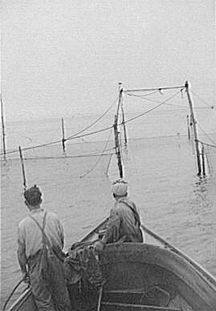
A 1940s-era trap fishing boat approaching the trap at 5:00 AM off Provincetown, Massachusetts. The trap is a large circle of net with a long funnel-like entrance set in to the tide stream. Fish, which follow the tide, get caught long before they realize it. Photo by Edwin Rosskam, U.S. Office of War Information. Courtesy Town of Provincetown.
- Pressure tactics
- Questioners sometimes want to pressure the respondent. For example, just as the respondent begins an answer to a difficult question, the questioner can interrupt with "What's the short answer?" or "We've got a long agenda here…"
- The questioner's purpose is to make it easier to attack the respondent's answer. Responding to pressure tactics can be tricky, but since everyone knows what's going on, a powerful response to the how-long-will-this-take question might be "It depends on what quality of answer you want."
- Cheap shots
- When someone proposes an alternative solution to a difficult problem, it's a cheap shot to ask, "How much will that cost?" or "How long will that take?" The questioner (and almost anyone) can guess that cheap shots will have embarrassing answers or no answers at all. That's what makes cheap shots cheap.
- Cheap shots are supposed to demonstrate weaknesses indirectly. It's usually best to respond honestly. For instance, "We don't know that yet, of course. Would you like an estimate by Friday?"
- Hoping for a shortcut
- Here the questioner hopes the response will be acceptable, and more direct tactics will be unnecessary. For instance, after discussing acceptable resource levels (in effect, supplying the "right answer"), asking what resources are needed might just elicit an acceptable response.
- Truth is your best ally. When asked for estimates on the spot, it's best to supply them with appropriate confidence levels: "Just as a guess, I'd say 100 person weeks plus or minus 50%. I can get you a better estimate by Friday."
- Trap construction
- Anybody can guess
that cheap-shot questions
will have embarrassing
answers. That's what makes
cheap shots cheap. - In a sequence of seemingly unrelated questions, with perhaps some truly irrelevant questions thrown in, the questioner lays a trap that constrains the respondent's answers to the "trap question."
- This technique relies on the desire of most of us to be consistent, and our wish to avoid backtracking or correcting previous responses. Trap construction questions that contain presuppositions [Brenner 2004] that conflict with the hypotheses of the trap question are especially effective. If you get trapped, look for presuppositions, and be willing to backtrack or be inconsistent.
- Zingers
- Usually asked publicly, zingers are vehicles for reminding bystanders of past infractions, or weaknesses of or accusations against the target. Example: "Weren't you the project manager for that Disaster last year?"
- Most people know what's really going on. Such questions (and likely, the questioner) are toxic to the organization. Choose whether or not to respond — a silent smile might be enough.
You might be wondering how to keep people from asking nasty questions. Try posting these articles. But the most effective tactic is to avoid asking them yourself. First in this series  Top
Top  Next Issue
Are you fed up with tense, explosive meetings? Are you or a colleague the target of a bully? Destructive conflict can ruin organizations. But if we believe that all conflict is destructive, and that we can somehow eliminate conflict, or that conflict is an enemy of productivity, then we're in conflict with Conflict itself. Read 101 Tips for Managing Conflict to learn how to make peace with conflict and make it an organizational asset. Order Now!
Footnotes
Your comments are welcome
Would you like to see your comments posted here? rbrendPtoGuFOkTSMQOzxner@ChacEgGqaylUnkmwIkkwoCanyon.comSend me your comments by email, or by Web form.About Point Lookout
 Thank you for reading this article. I hope you enjoyed it and
found it useful, and that you'll consider recommending it to a friend.
Thank you for reading this article. I hope you enjoyed it and
found it useful, and that you'll consider recommending it to a friend.
This article in its entirety was written by a human being. No machine intelligence was involved in any way.
Point Lookout is a free weekly email newsletter. Browse the archive of past issues. Subscribe for free.
Support Point Lookout by joining the Friends of Point Lookout, as an individual or as an organization.
Do you face a complex interpersonal situation? Send it in, anonymously if you like, and I'll give you my two cents.
Related articles
More articles on Workplace Politics:
 Obstructionist Tactics: II
- Teams and groups depend for their success on highly effective cooperation between their members. If
even one person is unable or unwilling to cooperate, the team's performance is limited. Here's Part
II of a little catalog of tactics.
 What You See Isn't Always What You Get
- We all engage in interpreting the behavior of others, usually without thinking much about it. Whenever
you notice yourself having a strong reaction to someone's behavior, consider the possibility that your
interpretation has outrun what you actually know.
 Backstabbing
- Much of what we call backstabbing is actually just straightforward attack — nasty, unethical,
even evil, but not backstabbing. What is backstabbing?
 Intentionally Misreporting Status: I
- When we report the status of the work we do, we sometimes confront the temptation to embellish the good
news or soften the bad news. How can we best deal with these obstacles to reporting status with integrity?
 Surviving Incompetence: II
- When your organization undertakes a misguided effort that will certainly fail, you have options. One
is to head for the exit. To search for a new position in such circumstances requires some care. Example:
an internal transfer might not really be an exit.
See also Workplace Politics, Effective Communication at Work and Conflict Management for more related articles.
Forthcoming issues of Point Lookout
 Coming April 24: Antipatterns for Time-Constrained Communication: 1
- Knowing how to recognize just a few patterns that can lead to miscommunication can be helpful in reducing the incidence of problems. Here is Part 1 of a collection of communication antipatterns that arise in technical communication under time pressure. Available here and by RSS on April 24.
 And on May 1: Antipatterns for Time-Constrained Communication: 2
- Recognizing just a few patterns that can lead to miscommunication can reduce the incidence of problems. Here is Part 2 of a collection of antipatterns that arise in technical communication under time pressure, emphasizing those that depend on content. Available here and by RSS on May 1.
Coaching services
I offer email and telephone coaching at both corporate and individual rates. Contact Rick for details at rbrendPtoGuFOkTSMQOzxner@ChacEgGqaylUnkmwIkkwoCanyon.com or (650) 787-6475, or toll-free in the continental US at (866) 378-5470.
Get the ebook!
Past issues of Point Lookout are available in six ebooks:
- Get 2001-2 in Geese Don't Land on Twigs (PDF, )
- Get 2003-4 in Why Dogs Wag (PDF, )
- Get 2005-6 in Loopy Things We Do (PDF, )
- Get 2007-8 in Things We Believe That Maybe Aren't So True (PDF, )
- Get 2009-10 in The Questions Not Asked (PDF, )
- Get all of the first twelve years (2001-2012) in The Collected Issues of Point Lookout (PDF, )
Are you a writer, editor or publisher on deadline? Are you looking for an article that will get people talking and get compliments flying your way? You can have 500-1000 words in your inbox in one hour. License any article from this Web site. More info
Follow Rick


Recommend this issue to a friend
Send an email message to a friend
rbrendPtoGuFOkTSMQOzxner@ChacEgGqaylUnkmwIkkwoCanyon.comSend a message to Rick
A Tip A Day feed
Point Lookout weekly feed
 The message of Point Lookout is unique. Help get the message out. Please donate to help keep Point Lookout available for free to everyone.
 My blog, Technical Debt for Policymakers, offers
resources, insights, and conversations of interest to policymakers who are concerned with managing
technical debt within their organizations. Get the millstone of technical debt off the neck of your
organization!
My blog, Technical Debt for Policymakers, offers
resources, insights, and conversations of interest to policymakers who are concerned with managing
technical debt within their organizations. Get the millstone of technical debt off the neck of your
organization!Beware any resource that speaks of "winning" at workplace politics or "defeating" it. You can benefit or not, but there is no score-keeping, and it isn't a game.
- Wikipedia has a nice article with a list of additional resources
- Some public libraries offer collections. Here's an example from Saskatoon.
- Check my own links collection
- LinkedIn's Office Politics discussion group
 Is every other day a tense, anxious, angry misery as you watch people around you, who couldn't even
think their way through a game of Jacks, win at workplace politics and steal the credit and glory
for just about everyone's best work including yours? Read 303 Secrets of Workplace Politics!Learn how to make your virtual global team sing.A Tip a Day arrives by email, or by RSS Feed, each business day. It's 20 to 30 words at most, and gives
you a new perspective on the hassles and rewards of work life. Most tips also contain links to
related articles. Free!Learn how to make meetings more productive — and more rare.
Is every other day a tense, anxious, angry misery as you watch people around you, who couldn't even
think their way through a game of Jacks, win at workplace politics and steal the credit and glory
for just about everyone's best work including yours? Read 303 Secrets of Workplace Politics!Learn how to make your virtual global team sing.A Tip a Day arrives by email, or by RSS Feed, each business day. It's 20 to 30 words at most, and gives
you a new perspective on the hassles and rewards of work life. Most tips also contain links to
related articles. Free!Learn how to make meetings more productive — and more rare.