A snare is a trap in which the force that keeps the victim trapped comes from the victim. Not all traps are snares. The classic bear trap isn't a snare, because it holds the victim by the force of a spring. An example of a snare is the (possibly apocryphal) "monkey trap."
An organization can become
ensnared when it is so
involved in maintaining
its current business that
it overlooks newer, and
much larger opportunitiesIn one version, you place a heavy narrow-mouthed container on the ground, and insert a sweet-smelling nut as bait. The monkey reaches in to grab the nut, but can't withdraw its fist, which is now too big to pull out. Unwilling to release the nut, the monkey is trapped. This is a snare because it is the monkey's own action that traps it.
Snares can be attractive, repulsive, or both. Attraction snares tempt the victim, who is ensnared by continued effort to attain the bait. Repulsion snares are just the opposite — the victim is ensnared by fear, and continued efforts to avoid the threat. Combination snares contain both bait and threat, which we usually call "incentives" and "disincentives."
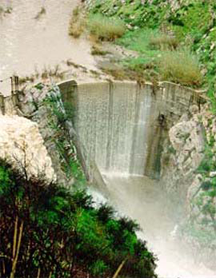
The Rindge Dam, in Malibu Canyon, California, is an example of a snare that's both attractive and repulsive. Completed in 1926, the dam was intended to control floods and conserve water for the Rindge Ranch, operated at the time by May Knight Rindge. These purposes were the attraction or incentive component of this snare. By 1950, however, the reservoir had largely filled with silt. It no longer serves its intended purpose, and the Rindge Ranch no longer exists. Reopening the stream would give habitat access to steelhead trout and other native species, and would increase silt flow to rebuild Malibu Beach. But it would require the relocation of upwards of one million cubic yards (cubic meters) of silt, removal of all or part of the dam, and according to the Malibu Creek Watershed Council, an estimated $5 to $40 million dollars. These efforts and costs are the repulsive parts, or disincentives, of the snare. Meanwhile, the dam has remained in place, essentially useless, for 50 years. Photo courtesy Malibu Complete.
One common repulsion snare is the sense that we can't cancel an effort because we have too much invested already. Eventually, we might complete the effort, but the cost can be so high that the net value returned is negative.
Repulsion snares can also arise from feelings. For instance, even thinking about failures can be painful, but unless we do, we can't learn from them. Here the snare consists of our own feelings about failure. It can prevent many organizations from holding retrospectives, which dooms them to repeat preventable failures.
An attraction snare can arise when an organization fails to exploit a new technology because it's excessively committed to an existing technology. For instance, many have argued that the US railroads failed to move into air transportation because they were ensnared by the rail passenger businesses they were already operating.
Attraction snares also work on people. "Golden handcuffs," a common element of retention strategies, uses the bait of inordinate financial rewards to persuade people to stay in positions perhaps longer than would otherwise be in their best interest. The bait often consists of stock options, but while those options vest, other factors set in: family, community, increasing age, aging of their expertise, and so on. Snared at first by the promise of disproportionate financial reward, employees can become ensnared in their jobs by these external factors.
Snares are obvious when you're not snared; they're much less so when you are. Look around you for snared colleagues and organizations. When you find one, ask yourself if you might already be ensnared in a similar way. Realizing that you're snared is the first step to finding your way out. Often, all you have to do is let go of the nut.  Top
Top  Next Issue
Is every other day a tense, anxious, angry misery as you watch people around you, who couldn't even think their way through a game of Jacks, win at workplace politics and steal the credit and glory for just about everyone's best work including yours? Read 303 Secrets of Workplace Politics, filled with tips and techniques for succeeding in workplace politics. More info
Your comments are welcome
Would you like to see your comments posted here? rbrendPtoGuFOkTSMQOzxner@ChacEgGqaylUnkmwIkkwoCanyon.comSend me your comments by email, or by Web form.About Point Lookout
 Thank you for reading this article. I hope you enjoyed it and
found it useful, and that you'll consider recommending it to a friend.
Thank you for reading this article. I hope you enjoyed it and
found it useful, and that you'll consider recommending it to a friend.
This article in its entirety was written by a human being. No machine intelligence was involved in any way.
Point Lookout is a free weekly email newsletter. Browse the archive of past issues. Subscribe for free.
Support Point Lookout by joining the Friends of Point Lookout, as an individual or as an organization.
Do you face a complex interpersonal situation? Send it in, anonymously if you like, and I'll give you my two cents.
Related articles
More articles on Workplace Politics:
 I've Got Your Number, Pal
- Recent research has uncovered a human tendency — possibly universal — to believe that we
know others better than others know them, and that we know ourselves better than others know themselves.
These beliefs, rarely acknowledged and often wrong, are at the root of many a toxic conflict of long standing.
 Management Debt: II
- As with technical debt, we incur management debt when we make choices that carry with them recurring
costs. How can we quantify management debt?
 The End-to-End Cost of Meetings: I
- By now, most of us realize how expensive meetings are. Um, well, maybe not. Here's a look at some of
the most-often overlooked costs of meetings.
 Rational Scope Management
- In project management, rational, responsible scope management helps us focus on the task at hand. But
rational scope management lets us adapt our work to changes in external factors, and changes in our
understanding of the problem.
 Exhibitionism and Conversational Narcissism at Work: I
- Exhibitionism is one of four themes of conversational narcissism. Behavior considered exhibitionistic
in this context is that which is intended to call the attention of others to the abuser. Here are six
examples that emphasize exhibitionistic behavior.
See also Workplace Politics and Critical Thinking at Work for more related articles.
Forthcoming issues of Point Lookout
 Coming April 24: Antipatterns for Time-Constrained Communication: 1
- Knowing how to recognize just a few patterns that can lead to miscommunication can be helpful in reducing the incidence of problems. Here is Part 1 of a collection of communication antipatterns that arise in technical communication under time pressure. Available here and by RSS on April 24.
 And on May 1: Antipatterns for Time-Constrained Communication: 2
- Recognizing just a few patterns that can lead to miscommunication can reduce the incidence of problems. Here is Part 2 of a collection of antipatterns that arise in technical communication under time pressure, emphasizing those that depend on content. Available here and by RSS on May 1.
Coaching services
I offer email and telephone coaching at both corporate and individual rates. Contact Rick for details at rbrendPtoGuFOkTSMQOzxner@ChacEgGqaylUnkmwIkkwoCanyon.com or (650) 787-6475, or toll-free in the continental US at (866) 378-5470.
Get the ebook!
Past issues of Point Lookout are available in six ebooks:
- Get 2001-2 in Geese Don't Land on Twigs (PDF, )
- Get 2003-4 in Why Dogs Wag (PDF, )
- Get 2005-6 in Loopy Things We Do (PDF, )
- Get 2007-8 in Things We Believe That Maybe Aren't So True (PDF, )
- Get 2009-10 in The Questions Not Asked (PDF, )
- Get all of the first twelve years (2001-2012) in The Collected Issues of Point Lookout (PDF, )
Are you a writer, editor or publisher on deadline? Are you looking for an article that will get people talking and get compliments flying your way? You can have 500-1000 words in your inbox in one hour. License any article from this Web site. More info
Follow Rick


Recommend this issue to a friend
Send an email message to a friend
rbrendPtoGuFOkTSMQOzxner@ChacEgGqaylUnkmwIkkwoCanyon.comSend a message to Rick
A Tip A Day feed
Point Lookout weekly feed
 The message of Point Lookout is unique. Help get the message out. Please donate to help keep Point Lookout available for free to everyone.
 My blog, Technical Debt for Policymakers, offers
resources, insights, and conversations of interest to policymakers who are concerned with managing
technical debt within their organizations. Get the millstone of technical debt off the neck of your
organization!
My blog, Technical Debt for Policymakers, offers
resources, insights, and conversations of interest to policymakers who are concerned with managing
technical debt within their organizations. Get the millstone of technical debt off the neck of your
organization!Beware any resource that speaks of "winning" at workplace politics or "defeating" it. You can benefit or not, but there is no score-keeping, and it isn't a game.
- Wikipedia has a nice article with a list of additional resources
- Some public libraries offer collections. Here's an example from Saskatoon.
- Check my own links collection
- LinkedIn's Office Politics discussion group
 Is every other day a tense, anxious, angry misery as you watch people around you, who couldn't even
think their way through a game of Jacks, win at workplace politics and steal the credit and glory
for just about everyone's best work including yours? Read 303 Secrets of Workplace Politics!Learn how to make your virtual global team sing.A Tip a Day arrives by email, or by RSS Feed, each business day. It's 20 to 30 words at most, and gives
you a new perspective on the hassles and rewards of work life. Most tips also contain links to
related articles. Free!Learn how to make meetings more productive — and more rare.
Is every other day a tense, anxious, angry misery as you watch people around you, who couldn't even
think their way through a game of Jacks, win at workplace politics and steal the credit and glory
for just about everyone's best work including yours? Read 303 Secrets of Workplace Politics!Learn how to make your virtual global team sing.A Tip a Day arrives by email, or by RSS Feed, each business day. It's 20 to 30 words at most, and gives
you a new perspective on the hassles and rewards of work life. Most tips also contain links to
related articles. Free!Learn how to make meetings more productive — and more rare.