Winston Churchill was born on November 30, 1874. It's a good thing, too, because his 69th birthday fell during the Teheran Conference, on November 30, 1943. The conference was the first meeting of the Allied Powers' three leaders — Churchill, Stalin, and Roosevelt — and things did not go smoothly.
On the last evening of the conference, Churchill's birthday, the British delegation hosted a birthday party in Churchill's honor, and the event helped defuse tensions between the three men. If Churchill had been born a few days earlier or later, the outcome of the Conference — and World War II — might then have been very different.
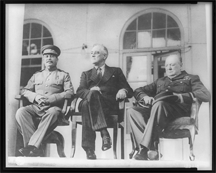
Stalin, Roosevelt and Churchill on the portico of the Soviet Embassy at the Teheran Conference in 1943. Only Roosevelt is dressed in civilian clothes. When the three sat for photographs like this one, Roosevelt nearly always sat between Churchill and Stalin. This might or might not have been intended to reflect the importance of the US to the coalition, but it is certainly a metaphor for the relationship of the three men. Photo courtesy U.S. Library of Congress.
In hostile collaborations, discomfort often arises from distrust, shame, or guilt. Distrust usually comes from preexisting information and experiences, some of which might be based on misinformation, disinformation, or misinterpretation.
Shame can come from the sense that the other collaborators are of disreputable character, and that associating with them is harmful. But our assessments of one another's characters are often erroneous, because they're vulnerable to the Fundamental Attribution Error.
Guilt sometimes results from misgivings about the goals of the collaboration. If the goals are inconsistent with our values, or if some of our collaborators might use the collaboration for purposes inconsistent with our values, guilt follows.
If our feelings of distrust, shame, or guilt are intense enough, we might undermine the collaboration, whether we know it or not. One approach to resolving this problem is to build trust, intentionally. Here are some tips for building trust.
- Avoid history
- Trying to resolve distrust by figuring out what caused it is a form of collaboration in itself, and since distrust already has a seat at the table, that collaboration isn't likely to succeed.
- Focus on right here, right now
- Create warm, If our feelings of distrust,
shame, or guilt are intense
enough, we might undermine
the collaboration, whether
we know it or notfriendly, positive experiences that provide energy for moving forward. Food sharing and socializing can be helpful. Still, if the atmosphere is toxic enough, the barbs will fly, though often cloaked in subtlety, irony, or humor, as they were at Teheran. - Create opportunities to practice joint problem solving
- A short excursion is a nice way to inject some joint problem solving that's unrelated to the content of the collaboration. Deciding routes, choosing places to eat, and deciding when to split the party and where to rejoin are all opportunities to practice consensus building.
Sometimes building trust can be just too difficult. One of the parties might have been promoted over another, or one might have abused the power of position, or one might perceive such abuse when none occurred, and so on. You can't change the past. If you can't replace the people involved, try adjusting the goals. Success with something easier might be the key to healing.  Top
Top  Next Issue
Are you fed up with tense, explosive meetings? Are you or a colleague the target of a bully? Destructive conflict can ruin organizations. But if we believe that all conflict is destructive, and that we can somehow eliminate conflict, or that conflict is an enemy of productivity, then we're in conflict with Conflict itself. Read 101 Tips for Managing Conflict to learn how to make peace with conflict and make it an organizational asset. Order Now!
For more on trust, see "The High Cost of Low Trust: I," Point Lookout for April 19, 2006.
For more details of the role of social interactions at the Teheran Conference, see Why the Allies Won, by Richard Overy (New York: W.W. Norton and Company, 1995) Order from Amazon.com
Your comments are welcome
Would you like to see your comments posted here? rbrendPtoGuFOkTSMQOzxner@ChacEgGqaylUnkmwIkkwoCanyon.comSend me your comments by email, or by Web form.About Point Lookout
 Thank you for reading this article. I hope you enjoyed it and
found it useful, and that you'll consider recommending it to a friend.
Thank you for reading this article. I hope you enjoyed it and
found it useful, and that you'll consider recommending it to a friend.
This article in its entirety was written by a human being. No machine intelligence was involved in any way.
Point Lookout is a free weekly email newsletter. Browse the archive of past issues. Subscribe for free.
Support Point Lookout by joining the Friends of Point Lookout, as an individual or as an organization.
Do you face a complex interpersonal situation? Send it in, anonymously if you like, and I'll give you my two cents.
Related articles
More articles on Workplace Politics:
 When Leaders Fight
- Organizations often pretend that feuds between leaders do not exist. But when the two most powerful
people in your organization go head-to-head, everyone in the organization suffers. How can you survive
a feud between people above you in the org chart?
 I've Got Your Number, Pal
- Recent research has uncovered a human tendency — possibly universal — to believe that we
know others better than others know them, and that we know ourselves better than others know themselves.
These beliefs, rarely acknowledged and often wrong, are at the root of many a toxic conflict of long standing.
 Management Debt: II
- As with technical debt, we incur management debt when we make choices that carry with them recurring
costs. How can we quantify management debt?
 Getting Into the Conversation
- In well-facilitated meetings, facilitators work hard to ensure that all participants have opportunities
to contribute. The story is rather different for many meetings, where getting into the conversation
can be challenging for some.
 Full Disclosure
- The term "full disclosure" is now a fairly common phrase, especially in news interviews and
in film and fiction thrillers involving government employees or attorneys. It also has relevance in
the knowledge workplace, and nuances associated with it can affect your credibility.
See also Workplace Politics and Conflict Management for more related articles.
Forthcoming issues of Point Lookout
 Coming April 24: Antipatterns for Time-Constrained Communication: 1
- Knowing how to recognize just a few patterns that can lead to miscommunication can be helpful in reducing the incidence of problems. Here is Part 1 of a collection of communication antipatterns that arise in technical communication under time pressure. Available here and by RSS on April 24.
 And on May 1: Antipatterns for Time-Constrained Communication: 2
- Recognizing just a few patterns that can lead to miscommunication can reduce the incidence of problems. Here is Part 2 of a collection of antipatterns that arise in technical communication under time pressure, emphasizing those that depend on content. Available here and by RSS on May 1.
Coaching services
I offer email and telephone coaching at both corporate and individual rates. Contact Rick for details at rbrendPtoGuFOkTSMQOzxner@ChacEgGqaylUnkmwIkkwoCanyon.com or (650) 787-6475, or toll-free in the continental US at (866) 378-5470.
Get the ebook!
Past issues of Point Lookout are available in six ebooks:
- Get 2001-2 in Geese Don't Land on Twigs (PDF, )
- Get 2003-4 in Why Dogs Wag (PDF, )
- Get 2005-6 in Loopy Things We Do (PDF, )
- Get 2007-8 in Things We Believe That Maybe Aren't So True (PDF, )
- Get 2009-10 in The Questions Not Asked (PDF, )
- Get all of the first twelve years (2001-2012) in The Collected Issues of Point Lookout (PDF, )
Are you a writer, editor or publisher on deadline? Are you looking for an article that will get people talking and get compliments flying your way? You can have 500-1000 words in your inbox in one hour. License any article from this Web site. More info
Follow Rick


Recommend this issue to a friend
Send an email message to a friend
rbrendPtoGuFOkTSMQOzxner@ChacEgGqaylUnkmwIkkwoCanyon.comSend a message to Rick
A Tip A Day feed
Point Lookout weekly feed
 The message of Point Lookout is unique. Help get the message out. Please donate to help keep Point Lookout available for free to everyone.
 My blog, Technical Debt for Policymakers, offers
resources, insights, and conversations of interest to policymakers who are concerned with managing
technical debt within their organizations. Get the millstone of technical debt off the neck of your
organization!
My blog, Technical Debt for Policymakers, offers
resources, insights, and conversations of interest to policymakers who are concerned with managing
technical debt within their organizations. Get the millstone of technical debt off the neck of your
organization!Beware any resource that speaks of "winning" at workplace politics or "defeating" it. You can benefit or not, but there is no score-keeping, and it isn't a game.
- Wikipedia has a nice article with a list of additional resources
- Some public libraries offer collections. Here's an example from Saskatoon.
- Check my own links collection
- LinkedIn's Office Politics discussion group
 Is every other day a tense, anxious, angry misery as you watch people around you, who couldn't even
think their way through a game of Jacks, win at workplace politics and steal the credit and glory
for just about everyone's best work including yours? Read 303 Secrets of Workplace Politics!Learn how to make your virtual global team sing.A Tip a Day arrives by email, or by RSS Feed, each business day. It's 20 to 30 words at most, and gives
you a new perspective on the hassles and rewards of work life. Most tips also contain links to
related articles. Free!Learn how to make meetings more productive — and more rare.
Is every other day a tense, anxious, angry misery as you watch people around you, who couldn't even
think their way through a game of Jacks, win at workplace politics and steal the credit and glory
for just about everyone's best work including yours? Read 303 Secrets of Workplace Politics!Learn how to make your virtual global team sing.A Tip a Day arrives by email, or by RSS Feed, each business day. It's 20 to 30 words at most, and gives
you a new perspective on the hassles and rewards of work life. Most tips also contain links to
related articles. Free!Learn how to make meetings more productive — and more rare.