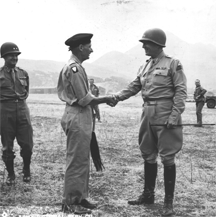
Gen. George S. Patton, Jr., bids farewell to Gen. Bernard Montgomery at the Palermo airport in Sicily on July 28, 1943. By then their rivalry, which was to become one of Gen. Eisenhower's most serious leadership difficulties, was nearing its zenith. Rivalry between team members can provide motivation for volunteering, but it comes at a high price paid in terms of team cohesion. It's tempting for team leaders to exploit or even stimulate rivalries, but the effect of such tactics is usually expensive and might even threaten the team's mission. Gen. Eisenhower dealt with the rivalry between the two generals by separating them as best he could, but political constraints on Eisenhower's authority probably prevented him from choosing more effective tactics. Photo from Images from World War II: The Early Years, compiled by Capt. John F. Curley, courtesy U.S. Army Center of Military History.
When leaders or managers ask teams or groups for volunteers for a specific task of limited duration, things usually work out fine. But sometimes we get too many volunteers, too few volunteers, or a basket of trouble. Here's Part II of a collection of tactics to help you through the sticky situations that sometimes arise when you ask for volunteers. See "Tactics for Asking for Volunteers: I," Point Lookout for December 19, 2007, for more.
- When the wrong people volunteer
- Some volunteers are already overloaded, but they volunteer because they want the assignment, or they believe that the task is politically valuable. Some care little about the task itself, and some lack necessary technical or interpersonal skills.
- If some people aren't ready or right for the task, in some cases, you can convert the situation into a developmental opportunity. Explain privately that you'd like to offer them a future assignment, if they address the issues you've noticed. Ask for their views, and together work towards a development plan that leads to a workable outcome for all concerned.
- If you take a developmental approach, don't promise the "next" opportunity — it commits you to making the offer, independent of the volunteer's progress. Keep future assignments contingent on progress against the development plan.
- If you believe that some people will never be right for the task in question, and if tasks of that kind are a significant fraction of your team's work, consider whether these people are better placed elsewhere. You might want to keep them on for their ability to contribute in other ways, but recognize that if you do, and if they continue to harbor other ambitions, you're at risk of accepting a chronic irritant that could escalate.
- When designating one leader might offend the others
- For a multi-person task group, it's usually best to designate a lead. This can be difficult or awkward, but failing to do so just shifts the burden of that difficulty to the task group. It leaves them with an ongoing problem whenever they must decide anything.
- Designating a Designating a lead after
you've selected the volunteers
can be trouble, especially
if more than one of
them wants the positionlead after you've selected the volunteers can be trouble, especially if more than one of them wants the position, or if those not selected might feel slighted. In effect, you've created a mini-mess — and some of these messes aren't so mini. - To avoid these problems, ask for volunteers for the lead before you ask for volunteers for the task — or select a lead in advance, privately. Once the task lead is named, everyone who volunteers knows the structure of the task group, and that clarity removes much of the risk of interpersonal difficulty.
Although we ask for volunteers to find people who actually want the assignments, the process often uncovers problems within the team. Addressing those problems might seem difficult, but it's preferable to avoiding asking for volunteers. First in this series  Top
Top  Next Issue
Are your projects always (or almost always) late and over budget? Are your project teams plagued by turnover, burnout, and high defect rates? Turn your culture around. Read 52 Tips for Leaders of Project-Oriented Organizations, filled with tips and techniques for organizational leaders. Order Now!
Your comments are welcome
Would you like to see your comments posted here? rbrendPtoGuFOkTSMQOzxner@ChacEgGqaylUnkmwIkkwoCanyon.comSend me your comments by email, or by Web form.About Point Lookout
 Thank you for reading this article. I hope you enjoyed it and
found it useful, and that you'll consider recommending it to a friend.
Thank you for reading this article. I hope you enjoyed it and
found it useful, and that you'll consider recommending it to a friend.
This article in its entirety was written by a human being. No machine intelligence was involved in any way.
Point Lookout is a free weekly email newsletter. Browse the archive of past issues. Subscribe for free.
Support Point Lookout by joining the Friends of Point Lookout, as an individual or as an organization.
Do you face a complex interpersonal situation? Send it in, anonymously if you like, and I'll give you my two cents.
Related articles
More articles on Personal, Team, and Organizational Effectiveness:
 The Deck Chairs of the Titanic: Obvious Waste
- Among the most futile and irrelevant actions ever taken in crisis is rearranging the deck chairs of
the Titanic, which, of course, never actually happened. But in the workplace, we engage in
activities just as futile and irrelevant, often outside our awareness. Recognition is the first step
to prevention.
 Hill Climbing and Its Limitations
- Finding a better solution by making small adjustments to your current solution is usually a good idea.
The key word is "usually."
 The Artful Shirker
- Most people who shirk work are fairly obvious about it, but some are so artful that the people around
them don't realize what's happening. Here are a few of the more sophisticated shirking techniques.
 Paradoxical Policies: I
- Although most organizational policies are constructive, many are outdated or nonsensical, and some are
actually counterproductive. Here's a collection of policies that would be funny if they weren't real.
 On Schedule Conflicts
- Schedule conflicts happen from time to time, even when the organization is healthy and all is well.
But when schedule conflicts are common, they might indicate that the organization is trying to do too
much with too few people.
See also Personal, Team, and Organizational Effectiveness for more related articles.
Forthcoming issues of Point Lookout
 Coming May 1: Antipatterns for Time-Constrained Communication: 2
- Recognizing just a few patterns that can lead to miscommunication can reduce the incidence of miscommunications. Here's Part 2 of a collection of antipatterns that arise in communication under time pressure, emphasizing those that depend on content. Available here and by RSS on May 1.
- And on May 8: Antipatterns for Time-Constrained Communication: 3
- Recognizing just a few patterns that can lead to miscommunication can reduce the incidence of problems. Here is Part 3 of a collection of antipatterns that arise in technical communication under time pressure, emphasizing past experiences of participants. Available here and by RSS on May 8.
Coaching services
I offer email and telephone coaching at both corporate and individual rates. Contact Rick for details at rbrendPtoGuFOkTSMQOzxner@ChacEgGqaylUnkmwIkkwoCanyon.com or (650) 787-6475, or toll-free in the continental US at (866) 378-5470.
Get the ebook!
Past issues of Point Lookout are available in six ebooks:
- Get 2001-2 in Geese Don't Land on Twigs (PDF, )
- Get 2003-4 in Why Dogs Wag (PDF, )
- Get 2005-6 in Loopy Things We Do (PDF, )
- Get 2007-8 in Things We Believe That Maybe Aren't So True (PDF, )
- Get 2009-10 in The Questions Not Asked (PDF, )
- Get all of the first twelve years (2001-2012) in The Collected Issues of Point Lookout (PDF, )
Are you a writer, editor or publisher on deadline? Are you looking for an article that will get people talking and get compliments flying your way? You can have 500-1000 words in your inbox in one hour. License any article from this Web site. More info
Follow Rick


Recommend this issue to a friend
Send an email message to a friend
rbrendPtoGuFOkTSMQOzxner@ChacEgGqaylUnkmwIkkwoCanyon.comSend a message to Rick
A Tip A Day feed
Point Lookout weekly feed
 My blog, Technical Debt for Policymakers, offers
resources, insights, and conversations of interest to policymakers who are concerned with managing
technical debt within their organizations. Get the millstone of technical debt off the neck of your
organization!
My blog, Technical Debt for Policymakers, offers
resources, insights, and conversations of interest to policymakers who are concerned with managing
technical debt within their organizations. Get the millstone of technical debt off the neck of your
organization! Bad boss, long commute, troubling ethical questions, hateful colleague? Learn what we can do when we
love the work but not the job.Learn how to make your virtual global team sing.Are you managing a change effort that faces rampant cynicism, passive non-cooperation, or
maybe even outright revolt?Learn how to make meetings more productive — and more rare.
Bad boss, long commute, troubling ethical questions, hateful colleague? Learn what we can do when we
love the work but not the job.Learn how to make your virtual global team sing.Are you managing a change effort that faces rampant cynicism, passive non-cooperation, or
maybe even outright revolt?Learn how to make meetings more productive — and more rare.