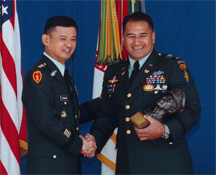
Chief Warrant Officer Nicholas Punimata is congratulated by Army Chief of Staff, General Eric Shinseki, upon receiving the General Douglas MacArthur award at a ceremony at the Pentagon on May 23, 2001. The award, sponsored by the U.S. Army and the General Douglas MacArthur Foundation, is given each year to company grade officers who exhibit extraordinary leadership abilities and embody the ideals embraced by Gen. MacArthur: Duty, Honor, Country. Gen. Shinseki himself was to exhibit those same extraordinary leadership abilities in 2003, just before the start of the Iraq War, when he testified before Congress that establishing control in Iraq after the invasion would require several hundred thousand troops. At the time of his testimony, he knew well that his testimony constituted a public break with the civilian leaders in the executive branch. Following his testimony, he was vilified and marginalized by those officials. His influence evaporated, and he retired in June 2003. Gen. Shinseki's testimony is an example of just what is needed to prevent both groupthink and pluralistic ignorance. The administration's action in marginalizing him, and possibly inhibiting any further comment by Gen. Shinseki or anyone else, is a clear example of the power leaders have to exploit both groupthink and pluralistic ignorance. Photo courtesy U.S. House of Representatives.
In "The Perils of Piecemeal Analysis: Content," Point Lookout for December 17, 2008, we defined piecemeal analysis as a group process for analyzing proposals — a real-time process of discussion, most often used when the group is subject to stress and tight time constraints. We saw there how the content of the discussion can degrade decision quality, but the form of the discussion itself also creates risks. Here are just a few.
- Elevated risk of groupthink
- Groupthink happens when the members of a group value consensus above decision quality. It's more likely to occur when there are social pressures against dissent, which is seen as a threat to harmony. In piecemeal analysis, when the leaders of the group begin to coalesce around rejection of the proposal, the rate of contribution of new objections can escalate so dramatically that proposers withdraw their ideas. But even if the proposer remains steadfast, groupthink can doom the proposal.
- Elevated risk of pluralistic ignorance
- Pluralistic ignorance is a group phenomenon in which anyone who dissents from an emerging consensus masks his or her dissent because of a belief that the unanimity of the group makes expressing dissent futile, and might even alienate the dissenter from the group. In this way, dissenters can actually be in the majority, while everyone believes the group is unanimous.
- Elevated risk of group polarization
- Group polarization is the tendency of groups to adopt positions more extreme than the group's members would adopt if acting alone. Polarization happens because people feel less responsible for the group decision than they would if they made it themselves; because those with strong opinions can persuade the hesitant or dubious; and because people become more comfortable with the extreme when they realize others support it. The group decision process is thus susceptible to positive feedback effects.
- Appearances can be liabilities
- If the proposal was presented with some polish, it can contain a latent message that it is fully developed and free of inconsistencies, even when it is a mere suggestion. After uncovering a number of objections that have no answers, people begin to see the proposal as all flash and little substance. Moreover, during the objection phase, the proposer necessarily adopts a defensive posture, which can look weak and self-serving. A piling-on effect can occur.
- Group memory plays a part
- If the group Once the proposer completes
the presentation, the
proposal itself adopts
a defensive posturehas experience with piecemeal analysis, role choices are likely to follow prior alignments. For instance, given a second proposition from the same proposer, previous objectors and defenders are likely to step forward, in similar roles. In this way, the results of previous events leak forward into the current event, independent of their relevance or the merits of the proposal.
If time allows — and it doesn't take much — avoid piecemeal analysis. Instead, do a careful study of the proposal, and then have a true debate. First in this series  Top
Top  Next Issue
Do you spend your days scurrying from meeting to meeting? Do you ever wonder if all these meetings are really necessary? (They aren't) Or whether there isn't some better way to get this work done? (There is) Read 101 Tips for Effective Meetings to learn how to make meetings much more productive and less stressful — and a lot more rare. Order Now!
Your comments are welcome
Would you like to see your comments posted here? rbrendPtoGuFOkTSMQOzxner@ChacEgGqaylUnkmwIkkwoCanyon.comSend me your comments by email, or by Web form.About Point Lookout
 Thank you for reading this article. I hope you enjoyed it and
found it useful, and that you'll consider recommending it to a friend.
Thank you for reading this article. I hope you enjoyed it and
found it useful, and that you'll consider recommending it to a friend.
This article in its entirety was written by a human being. No machine intelligence was involved in any way.
Point Lookout is a free weekly email newsletter. Browse the archive of past issues. Subscribe for free.
Support Point Lookout by joining the Friends of Point Lookout, as an individual or as an organization.
Do you face a complex interpersonal situation? Send it in, anonymously if you like, and I'll give you my two cents.
Related articles
More articles on Effective Meetings:
 Dispersity Adversity
- Geographically and culturally dispersed project teams are increasingly common, as we become more travel-averse
and more bedazzled by communication technology. But people really do work better together face-to-face.
Here are some tips for managing dispersed teams.
 Contributions, Open and Closed
- We can classify contributions to discussions according to the likelihood that they stimulate new thought.
The more open they are, the more they stimulate new thought. How can we encourage open contributions?
 Toward More Engaging Virtual Meetings: I
- Keeping attendees engaged in virtual meetings is a widely sought but rarely achieved objective. Here
is Part I of a set of simple techniques to help facilitators enhance attendee engagement.
 Perfectionism and Avoidance
- Avoiding tasks we regard as unpleasant, boring, or intimidating is a pattern known as procrastination.
Perfectionism is another pattern. The interplay between the two makes intervention a bit tricky.
 Self-Importance and Conversational Narcissism at Work: I
- Conversational narcissism is a set of behaviors that participants use to focus the exchange on their
own self-interest rather than the shared objective. This post emphasizes the role of these behaviors
in advancing the participant's sense of self-importance.
See also Effective Meetings and Problem Solving and Creativity for more related articles.
Forthcoming issues of Point Lookout
 Coming May 1: Antipatterns for Time-Constrained Communication: 2
- Recognizing just a few patterns that can lead to miscommunication can reduce the incidence of miscommunications. Here's Part 2 of a collection of antipatterns that arise in communication under time pressure, emphasizing those that depend on content. Available here and by RSS on May 1.
- And on May 8: Antipatterns for Time-Constrained Communication: 3
- Recognizing just a few patterns that can lead to miscommunication can reduce the incidence of problems. Here is Part 3 of a collection of antipatterns that arise in technical communication under time pressure, emphasizing past experiences of participants. Available here and by RSS on May 8.
Coaching services
I offer email and telephone coaching at both corporate and individual rates. Contact Rick for details at rbrendPtoGuFOkTSMQOzxner@ChacEgGqaylUnkmwIkkwoCanyon.com or (650) 787-6475, or toll-free in the continental US at (866) 378-5470.
Get the ebook!
Past issues of Point Lookout are available in six ebooks:
- Get 2001-2 in Geese Don't Land on Twigs (PDF, )
- Get 2003-4 in Why Dogs Wag (PDF, )
- Get 2005-6 in Loopy Things We Do (PDF, )
- Get 2007-8 in Things We Believe That Maybe Aren't So True (PDF, )
- Get 2009-10 in The Questions Not Asked (PDF, )
- Get all of the first twelve years (2001-2012) in The Collected Issues of Point Lookout (PDF, )
Are you a writer, editor or publisher on deadline? Are you looking for an article that will get people talking and get compliments flying your way? You can have 500-1000 words in your inbox in one hour. License any article from this Web site. More info
Follow Rick


Recommend this issue to a friend
Send an email message to a friend
rbrendPtoGuFOkTSMQOzxner@ChacEgGqaylUnkmwIkkwoCanyon.comSend a message to Rick
A Tip A Day feed
Point Lookout weekly feed
 My blog, Technical Debt for Policymakers, offers
resources, insights, and conversations of interest to policymakers who are concerned with managing
technical debt within their organizations. Get the millstone of technical debt off the neck of your
organization!
My blog, Technical Debt for Policymakers, offers
resources, insights, and conversations of interest to policymakers who are concerned with managing
technical debt within their organizations. Get the millstone of technical debt off the neck of your
organization! Bad boss, long commute, troubling ethical questions, hateful colleague? Learn what we can do when we
love the work but not the job.Learn how to make your virtual global team sing.Are you managing a change effort that faces rampant cynicism, passive non-cooperation, or
maybe even outright revolt?Learn how to make meetings more productive — and more rare.
Bad boss, long commute, troubling ethical questions, hateful colleague? Learn what we can do when we
love the work but not the job.Learn how to make your virtual global team sing.Are you managing a change effort that faces rampant cynicism, passive non-cooperation, or
maybe even outright revolt?Learn how to make meetings more productive — and more rare.