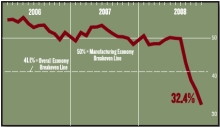
Recent data for the Purchasing Managers Index (PMI), which is a composite index based on new orders, inventory levels, production, supplier deliveries, and the employment environment. The index for December 2008 was 32.4, which indicates strong economic contraction. The Backlog of Orders Index is at the lowest level since tracking began in January 1993. The steady stream of news reports on data such as this is of course depressing, but most news outlets don't show readers and viewers the graphics that go along with the data. When you look at the graphs, you'll get a much clearer picture of where we are. Knowledge is power. Check out the data from the New York Federal Reserve Bank. Graphic courtesy The Institute for Supply Management.
The anticipatory layoff — one executed by a profitable company that isn't yet in trouble — is an important difference between the current economic crisis and past slowdowns. That's why, as an employee, preparing for layoffs is smart strategy now, even if your own company is doing well so far.
If you don't want to be among those designated for layoff, there are things you can start doing now to enhance your chances of continued employment. I've organized them into three categories. The inside stuff includes actions you can take to strengthen your frame of mind and help you maintain a positive attitude. Relationship-oriented actions include things to do that involve your relationships with colleagues, co-workers and others. And situational actions include things to do and decisions to make that pertain to your general situation at work.
Here are some tips for strengthening yourself emotionally to make your attitude more positive and appealing to those around you.
- Attend to your health
- If you're healthy, you feel better emotionally. Exploit your health insurance, if you have it, to get minor things taken care of. Smoking cessation is especially useful, because it helps your health, and makes you more attractive as an employee, and saves lots of cash. But don't do anything elective that will keep you out of work for extended periods, because despite any legal protections, being out on sick leave can make you more vulnerable to layoff.
- Attend to your finances
- Whatever might happen, you'll deal with it better if your finances are in good shape. Some signs of trouble: carrying balances on credit cards, bills in arrears, and phone calls from creditors. If you have chronic financial problems, recognize that you need advice and counseling — and get help from a reputable noncommercial agency. If part of the problem is marital, seek counseling for that, too.
- Work-life balance might now mean longer hours
- In good times, working long hours threatens happiness at home. But in troubled times, losing your job altogether is a greater threat to home life. If you think that working longer hours will help make you more valuable than your co-workers, get the support of your family and go for it.
- Keep your personal troubles private
- Foreclosure, divorce, illness, family problems — keep all of it private. When managers select people to terminate, they sometimes consider personal stability. Telling people about your personal problems probably won't help you keep your job. If you need to talk to someone, and family isn't enough, seek a counselor or a therapist.
- Telling people about
your personal problems
probably won't help
you keep your job
Most important, be the most positive person you know. This is more than just acting as if you have a positive attitude. You must be positive. Do whatever you can do to make your job, your finances, your family and your social situation as secure as they can be.
We'll address tips for relationships next time. Next in this series  Top
Top  Next Issue
Is every other day a tense, anxious, angry misery as you watch people around you, who couldn't even think their way through a game of Jacks, win at workplace politics and steal the credit and glory for just about everyone's best work including yours? Read 303 Secrets of Workplace Politics, filled with tips and techniques for succeeding in workplace politics. More info
Your comments are welcome
Would you like to see your comments posted here? rbrendPtoGuFOkTSMQOzxner@ChacEgGqaylUnkmwIkkwoCanyon.comSend me your comments by email, or by Web form.About Point Lookout
 Thank you for reading this article. I hope you enjoyed it and
found it useful, and that you'll consider recommending it to a friend.
Thank you for reading this article. I hope you enjoyed it and
found it useful, and that you'll consider recommending it to a friend.
This article in its entirety was written by a human being. No machine intelligence was involved in any way.
Point Lookout is a free weekly email newsletter. Browse the archive of past issues. Subscribe for free.
Support Point Lookout by joining the Friends of Point Lookout, as an individual or as an organization.
Do you face a complex interpersonal situation? Send it in, anonymously if you like, and I'll give you my two cents.
Related articles
More articles on Emotions at Work:
 Responding to Rumors
- Have you ever heard nasty rumors about yourself? When rumors are damaging, they can hurt our careers,
our self-esteem, and even our health. Sadly, our response to rumors often compounds the serious damage
they do.
 Irrational Self-Interest
- When we try to influence others, especially large groups or entire companies, we sometimes create packages
of incentives and disincentives that are intended to affect behavior. These strategies usually assume
that people make choices on rational grounds. Is this assumption valid?
 Reverse Micromanagement
- Micromanagement is too familiar to too many of us. Less familiar is inappropriate interference in the
reverse direction — in the work of our supervisors or even higher in the chain. Disciplinary action
isn't always helpful, especially when some of the causes of reverse micromanagement are organizational.
 Creating Trust
- What can you do when you discover that the environment at work is permeated with distrust? Your position
in the organization does affect your choices, but here are some suggestions that might be helpful to anyone.
 Good Change, Bad Change: I
- Change is all around. Some changes are welcome and some not, but when we distinguish good change from
bad, we often get it wrong. Why?
See also Emotions at Work and Managing Your Boss for more related articles.
Forthcoming issues of Point Lookout
 Coming May 1: Antipatterns for Time-Constrained Communication: 2
- Recognizing just a few patterns that can lead to miscommunication can reduce the incidence of miscommunications. Here's Part 2 of a collection of antipatterns that arise in communication under time pressure, emphasizing those that depend on content. Available here and by RSS on May 1.
- And on May 8: Antipatterns for Time-Constrained Communication: 3
- Recognizing just a few patterns that can lead to miscommunication can reduce the incidence of problems. Here is Part 3 of a collection of antipatterns that arise in technical communication under time pressure, emphasizing past experiences of participants. Available here and by RSS on May 8.
Coaching services
I offer email and telephone coaching at both corporate and individual rates. Contact Rick for details at rbrendPtoGuFOkTSMQOzxner@ChacEgGqaylUnkmwIkkwoCanyon.com or (650) 787-6475, or toll-free in the continental US at (866) 378-5470.
Get the ebook!
Past issues of Point Lookout are available in six ebooks:
- Get 2001-2 in Geese Don't Land on Twigs (PDF, )
- Get 2003-4 in Why Dogs Wag (PDF, )
- Get 2005-6 in Loopy Things We Do (PDF, )
- Get 2007-8 in Things We Believe That Maybe Aren't So True (PDF, )
- Get 2009-10 in The Questions Not Asked (PDF, )
- Get all of the first twelve years (2001-2012) in The Collected Issues of Point Lookout (PDF, )
Are you a writer, editor or publisher on deadline? Are you looking for an article that will get people talking and get compliments flying your way? You can have 500-1000 words in your inbox in one hour. License any article from this Web site. More info
Follow Rick


Recommend this issue to a friend
Send an email message to a friend
rbrendPtoGuFOkTSMQOzxner@ChacEgGqaylUnkmwIkkwoCanyon.comSend a message to Rick
A Tip A Day feed
Point Lookout weekly feed
 My blog, Technical Debt for Policymakers, offers
resources, insights, and conversations of interest to policymakers who are concerned with managing
technical debt within their organizations. Get the millstone of technical debt off the neck of your
organization!
My blog, Technical Debt for Policymakers, offers
resources, insights, and conversations of interest to policymakers who are concerned with managing
technical debt within their organizations. Get the millstone of technical debt off the neck of your
organization! Bad boss, long commute, troubling ethical questions, hateful colleague? Learn what we can do when we
love the work but not the job.Learn how to make your virtual global team sing.Are you managing a change effort that faces rampant cynicism, passive non-cooperation, or
maybe even outright revolt?Learn how to make meetings more productive — and more rare.
Bad boss, long commute, troubling ethical questions, hateful colleague? Learn what we can do when we
love the work but not the job.Learn how to make your virtual global team sing.Are you managing a change effort that faces rampant cynicism, passive non-cooperation, or
maybe even outright revolt?Learn how to make meetings more productive — and more rare.