Voluntary turnover after a period of difficulty for job-seekers is perhaps the most expensive form of turnover, because that's when capable people leave. When we talk of retention, it's these people we most often have in mind.
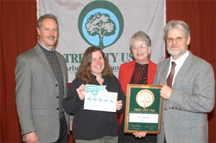
An example of a program that does work: recognition. Here the Wisconsin Secretary of Natural Resources recognizes the Town of Wescott with the Tree City 2005 Award. Present are the Secretary, the Town Forester, a Town Board Member and the Town Board Chairman. Photo courtesy Wisconsin Department of Natural Resources.
We usually compare the benefits of retention to the cost of hiring replacements and bringing them "up to speed." But new hires also depress the productivity of existing employees. For instance, existing employees have to build relationships with new people; they have to support the informal orientation that continues after hiring; and they're more likely to voluntarily terminate, or get scooped up from afar by the people who left.
Since these effects, and others, are "off the books," retention is worth far more than we realize. The actual returns on retention investment therefore justify examining new possibilities.
The most obvious tactics involve compensation and benefits, but since any organization can offer these items, they have relatively low return on investment. By contrast, exploiting the unique attributes of your organization can yield better results, because competitive organizations can't match them.
The global economy is gradually assuming a configuration in which retention will become a competitive advantage. We can continue using the same tired tactics, and continue working with whoever stays — or we can try some new approaches, and see what happens. Here are some retention tactics that are likely to have higher returns.
- Make life easy
- Help people with errands by providing access to services on-site or near-site: day care, car wash, banking, dry cleaning, health club, and convenience market. Or form a joint effort with your business neighbors. In that critical stay-or-move discussion between two spouses, high quality of life strengthens the arguments of anyone who advocates staying.
- Use flextime and telecommuting
- Exploiting the unique
attributes of your
organization can yield
superior results,
because competitive
organizations can't
match themTwo-income and single-parent families are especially burdened by rigid schedules. For roles compatible with flextime or telecommuting, find a way to make it happen. The reduction of load on your internal resources alone will fund the program, but you'll also gain a recruiting tool. - Support discount programs
- Provide or facilitate services that fit your demographics: movie and theater tickets, subsidized cafeterias, mass transit passes, health club discounts, and wholesale club memberships. These program costs are mostly administrative, and administration can be automated. See "Food for Thought," Point Lookout for May 22, 2002, for more.
- Emphasize recognition, education, growth, and opportunity
- Good people need new and more significant challenges and responsibilities, and they want to know that their achievements matter. Offering them that is easier than you think. For instance, you can subsidize adult learning.
- Stop driving them out
- Rumors, archaic and draconian policies, ongoing destructive conflict, and toxic politics do more to drive people away than anything you can do to keep them on. When you apply significant resources to resolving these issues, retention might be the least of the benefits. See "Practice Positive Politics," Point Lookout for August 31, 2005, for more.
Most job shifters convince themselves that their new jobs are steps up, and maybe they are. But people do tend to overestimate these opportunities. It's a grass-is-greener thing, so make your own grass as green as it can be.  Top
Top  Next Issue
Are your projects always (or almost always) late and over budget? Are your project teams plagued by turnover, burnout, and high defect rates? Turn your culture around. Read 52 Tips for Leaders of Project-Oriented Organizations, filled with tips and techniques for organizational leaders. Order Now!
Reader Comments
- Tracy Adams
- One additional thought on employee retention: there has been a lot of research done around the idea that people take a job for the company and leave a job because of their manager. It would seem then to follow that training managers to be better managers would reduce employee turnover. I can tell you that in my own organization, I support two groups that do very similar work, but turnover in one group is much higher than the other. Since benefits, pay, perks, etc. are identical, one of the clearly differentiating factors is the two different managers.
- Keep the good stuff coming!
- Rick: Certainly sounds right to me. And sometimes managers who report to different managers get different direction and face different constraints. So even though one seems to do better than the other, the source of the differences can be higher in the organization. In some sense, nearly everyone who gets promoted is a "first-time something" and needs training or mentoring to do that job well.
- Deborah McMillin
- Just finished reading this week's newsletter about retention. Hmm. I have read in numerous newsletters and magazines and heard on TV news programs the same advice you are suggesting in hopes of retaining current employees. My response is always the same, "If they want to leave, then leave."
- As you say, "Most job shifters convince themselves that their new jobs are steps up, and maybe they are." So, good-bye and good luck. Why should I spend my time, effort, and money to keep people who don't want to be here in the first place?
- Life is not a bowl of ice cream day in and day out; you regularly need to eat your vegetables in order to maintain your health.
- It seems to me that frequent job shifters would also be remote control junkies type of people always anxious to see what else is available hoping the next shift is more entertaining, exciting, etc. Sometimes it is, but most of the time it isn't.
- There is a reason what we do is called "work." It takes sustained effort. This appears to be a characteristic some are lacking these days — especially those who want to be president of the company a week after they arrive.
- I say again, if they want to leave "so long, far well, auf wiedersehen, good-bye!"
- Rick: In many cases, I'm sure, this approach is appropriate. But not every case is this simple. The comment from Tracy, above, clearly suggests that not all employee departures are likely to be due to personal decisions (or quirks, or issues) of the departing employee. Tracy's observation is that when you see a cluster of voluntary departures in one area in the organization, it might be worth considering the possibility that the manager's approach to management might be a factor. I would only add to that that there could be other factors as well: the location of the group, the presence of a bully in the group, or any number of other activities or environmental factors that could cause someone to leave. Simply sitting by a letting people depart, without investigating why, might be a mistake. Two very pragmatic reasons: (a) turnover is expensive, and (b) something really bad (even illegal) might be happening.
Your comments are welcome
Would you like to see your comments posted here? rbrenaXXxGCwVgbgLZDuRner@ChacDjdMAATPdDNJnrSwoCanyon.comSend me your comments by email, or by Web form.
About Point Lookout
 Thank you for reading this article. I hope you enjoyed it and
found it useful, and that you'll consider recommending it to a friend.
Thank you for reading this article. I hope you enjoyed it and
found it useful, and that you'll consider recommending it to a friend.
This article in its entirety was written by a human being. No machine intelligence was involved in any way.
Point Lookout is a free weekly email newsletter. Browse the archive of past issues. Subscribe for free.
Support Point Lookout by joining the Friends of Point Lookout, as an individual or as an organization.
Do you face a complex interpersonal situation? Send it in, anonymously if you like, and I'll give you my two cents.
Related articles
More articles on Personal, Team, and Organizational Effectiveness:
 The Zebra Effect
- If you're feeling overwhelmed by all the items on your To-Do list, and if you start on one only to realize
that you have to tackle three more you didn't know about before you can finish that one, you could be
experiencing the Zebra Effect.
 The Mind Reading Trap
- When we think, "Paul doesn't trust me," we could be fooling ourselves into believing that
we can read his mind. Unless he has directly expressed his distrust, we're just guessing, and we can
reach whatever conclusion we wish, unconstrained by reality. In project management, as anywhere else,
that's a recipe for trouble.
 When Meetings Boil Over
- At any time, without warning, you can find yourself in a meeting that boils over. Sometimes tempers
rise, then voices rise, and then people yell and scream. What can a team do when meetings threaten to
boil over — and when they do?
 Seven Ways to Get Nowhere
- Ever have the feeling that you're getting nowhere? You have the sense of movement, but you're making
no real progress towards the goal. How does this happen? What can you do about it?
 Flattery and Its Perils
- Flattery is a tool of manipulation. When skillfully employed, it's difficult to distinguish from praise
or admiration. When we confuse flattery with praise, we are in peril.
See also Personal, Team, and Organizational Effectiveness for more related articles.
Forthcoming issues of Point Lookout
 Coming October 1: On the Risks of Obscuring Ignorance
- When people hide their ignorance of concepts fundamental to understanding the issues at hand, they expose their teams and organizations to a risk of making wrong decisions. The organizational costs of the consequences of those decisions can be unlimited. Available here and by RSS on October 1.
 And on October 8: Responding to Workplace Bullying
- Effective responses to bullying sometimes include "pushback tactics" that can deter perpetrators from further bullying. Because perpetrators use some of these same tactics, some people have difficulty employing them. But the need is real. Pushing back works. Available here and by RSS on October 8.
Coaching services
I offer email and telephone coaching at both corporate and individual rates. Contact Rick for details at rbrenaXXxGCwVgbgLZDuRner@ChacDjdMAATPdDNJnrSwoCanyon.com or (650) 787-6475, or toll-free in the continental US at (866) 378-5470.
Get the ebook!
Past issues of Point Lookout are available in six ebooks:
- Get 2001-2 in Geese Don't Land on Twigs (PDF, )
- Get 2003-4 in Why Dogs Wag (PDF, )
- Get 2005-6 in Loopy Things We Do (PDF, )
- Get 2007-8 in Things We Believe That Maybe Aren't So True (PDF, )
- Get 2009-10 in The Questions Not Asked (PDF, )
- Get all of the first twelve years (2001-2012) in The Collected Issues of Point Lookout (PDF, )
Are you a writer, editor or publisher on deadline? Are you looking for an article that will get people talking and get compliments flying your way? You can have 500-1000 words in your inbox in one hour. License any article from this Web site. More info
Follow Rick


Recommend this issue to a friend
Send an email message to a friend
rbrenaXXxGCwVgbgLZDuRner@ChacDjdMAATPdDNJnrSwoCanyon.comSend a message to Rick
A Tip A Day feed
Point Lookout weekly feed
 My blog, Technical Debt for Policymakers, offers
resources, insights, and conversations of interest to policymakers who are concerned with managing
technical debt within their organizations. Get the millstone of technical debt off the neck of your
organization!
My blog, Technical Debt for Policymakers, offers
resources, insights, and conversations of interest to policymakers who are concerned with managing
technical debt within their organizations. Get the millstone of technical debt off the neck of your
organization! Bad boss, long commute, troubling ethical questions, hateful colleague? Learn what we can do when we
love the work but not the job.Learn how to make your virtual global team sing.Are you managing a change effort that faces rampant cynicism, passive non-cooperation, or
maybe even outright revolt?Learn how to make meetings more productive — and more rare.
Bad boss, long commute, troubling ethical questions, hateful colleague? Learn what we can do when we
love the work but not the job.Learn how to make your virtual global team sing.Are you managing a change effort that faces rampant cynicism, passive non-cooperation, or
maybe even outright revolt?Learn how to make meetings more productive — and more rare.