Conflict isn't necessarily Skip to the Details:
How To Orderbad — it can be constructive,
especially when people with opposing views work together to produce a new position that all
can support. Often the results are better than any one of the contributors' initial
positions. And conflict can be destructive, too, when oppositional, reasoned debate turns
to personal attacks, sniping, exclusion, silence, gossip, or worse — violence and other
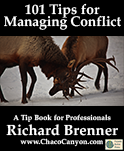
forms of abuse. 101 Tips for Managing Conflict shows you how to encourage constructive conflict, how to
intervene to end destructive conflict, and how to create an environment that minimizes the
occurrence of destructive conflict.
 In my own experience, and in the course of working with clients in my
consulting and coaching practices, I've learned a lot about what works and what doesn't when we
try to deal with conflict at work. Some of what I've learned is just good practice and has
appeared in the literature over the years. But much is very new, developed in response to the
rapid structural and technological change that has swept through today's office.
In my own experience, and in the course of working with clients in my
consulting and coaching practices, I've learned a lot about what works and what doesn't when we
try to deal with conflict at work. Some of what I've learned is just good practice and has
appeared in the literature over the years. But much is very new, developed in response to the
rapid structural and technological change that has swept through today's office.
This tip book is both like and unlike many other collections of ideas for dealing with conflict. Like others, it's packed with ideas and suggestions that will help you deal with destructive conflict once it erupts.
Unlike others, this tip book also provides
- Looking specifically for tips for targets of bullies? Check out my tips book 101 Tips for Targets of Workplace Bullies!Suggestions for changing the way you experience conflict, to help you come to peace even with situations you cannot change
- Ideas organizational leaders and managers can use to adjust the organizational culture to make conflict more constructive and a lot less painful for all
- Insights that help you understand the systemic sources of conflict
Some sample tips
Here's a sample:
- "Personality clash" is a bogus concept
The "personality clash" model of destructive conflict represents some conflicts as arising solely from incompatibilities between two people. Rarely is this the case — the causes of destructive conflict are usually systemic, involving several people, if not everyone, and sometimes people who aren't even present. - Identify performance issues
- Bullying behavior is a performance issue that might call for discipline. Tolerating bullying behavior by a subordinate is a performance issue for the supervisor, and it, too, might call for discipline. Tolerating the toleration of bullying behavior on the part of a sub-subordinate is also a performance issue that might call for discipline. And so on.
- Avoid the Fundamental Attribution Error
- As humans, we repeatedly make the Fundamental Attribution Error — we attribute behavior to character or disposition rather than to situation or context. Consciously try to understand others in terms of the situations they face, rather than their track records, origins, alliances, professions or affiliations.
Details and how to order
This item is also available through ClickBank.com, the largest seller of downloadable products and software. If you prefer, you can .
This book has an ISBN of 978-1-938932-17-5.
Table of contents
Click the folder icons to reveal (or hide) individual chapter content summaries, or:
- 1Conflict can be constructive
- 2Conflict is part of life
- 3Emotions are an inherent part of conflict
- 4The problem is rarely the problem
- 5"Personality clash" is a bogus concept
- 6Conflict can be managed, but not avoided or eliminated
- 7Know what email is good for
- 8When in doubt, assume the best
- 9Find at least three interpretations
- 10Beware: email can be dangerous
- 11Use mixed case
- 12Don't type when you're angry
- 13Adopt a take-it-outside norm
- 14Email doesn't always arrive
- 15Don't send "Tweaking CCs"
- 16Don't worry about receiving a Tweaking CC
- 17If a subordinate sends Tweaking CCs, intervene
- 18Take action if you receive the CC of a Tweaking CC
- 19Avoid the Fundamental Attribution Error
- 20In communications, safety depends, in part, on the medium
- 21For issues with high emotional content, avoid written communications
- 22Pressure doesn't help
- 23Crowding is expensive
- 24Thought workers need quiet
- 25Negotiating positions are sometimes constrained
- 26Deal with geographic dispersion fairly
- 27Structure roles to encourage collaboration
- 28Attachment to a position might not be what it seems
- 29The cheapest way to operate is with enough resources
- 30Don't contribute to a blaming environment
- 31Intervene in wars among subordinates
- 32Be open to the ideas of others
- 33Rumors about a conflict are toxic
- 34For tense meetings, use a facilitator
- 35When a meeting boils over, adjourn
- 36Value relationships
- 37Assigning blame or credit to one person is futile
- 38Deal with conflict — don't suppress it
- 39Deploy and track conflict metrics
- 40Change makes organizations vulnerable
- 41Conflict is complex
- 42Repeated patterns are regulated
- 43Competition is expensive
- 44If you're inside a troubled system, get help
- 45Closed systems are more vulnerable than open ones
- 46Preparation helps
- 47Conflict rarely involves only two people
- 48Understand the effects of accounting
- 49Nobody was born yesterday
- 50One person is rarely the root cause
- 51Systems need to vent
- 52Breathe
- 53Avoid the word "but"
- 54Demand decorum
- 55Know the common trigger phrases
- 56Be positive when you express concerns
- 57Know how being trapped feels
- 58Avoid the trap of implied accusations
- 59Be open about your misgivings
- 60When conflict hurts, talk about it
- 61Become a master of the apology
- 62Inappropriate apologies don't work
- 63Manage your state of mind by breathing
- 64Let people know how you feel
- 65Know what you're really upset about
- 66Expand your choices
- 67Wait to hear it all
- 68Assume that it isn't an insult
- 69Be open about your feelings
- 70Get off your dreadmill
- 71Feel your feelings
- 72Everything is easier with support
- 73Practice happiness
- 74Anger is rarely your best choice
- 75Use humor with precision
- 76Sarcasm is OK between friends
- 77Manage your touching
- 78Choose a good time of the day to work it out
- 79Choose a good day of the week to work it out
- 80Avoid blaming
- 81When working on it, stay focused
- 82Validate
- 83Take breaks
- 84Deal with obstacles
- 85Take turns in discussion
- 86Use "I" statements
- 87Avoid analogies
- 88Notice your breathing
- 89Make an appointment to work it out
- 90Know how to spot a bully
- 91Respond effectively to pleas for help
- 92Distinguish the mob from its leader
- 93Don't blame the target
- 94Keep your cool
- 95If you're the target, don't retaliate
- 96Don't run or hide
- 97Waiting them out doesn't work
- 98Self-defense is part of your life
- 99Document all incidents and file formal complaints
- 100Some bullies are irrational
- 101Identify performance issues
Follow Rick


Send an email message to a friend
rbrendPtoGuFOkTSMQOzxner@ChacEgGqaylUnkmwIkkwoCanyon.comSend a message to Rick
A Tip A Day feed
Point Lookout weekly feed
 My blog, Technical Debt for Policymakers, offers
resources, insights, and conversations of interest to policymakers who are concerned with managing
technical debt within their organizations. Get the millstone of technical debt off the neck of your
organization!
My blog, Technical Debt for Policymakers, offers
resources, insights, and conversations of interest to policymakers who are concerned with managing
technical debt within their organizations. Get the millstone of technical debt off the neck of your
organization!Point Lookout by
starting your Amazon search here

 Learn how to make meetings more productive — and more rare.Save a bundle and even more important save time! Order the Combo Package and download all ebooks
and tips books at once.
Learn how to make meetings more productive — and more rare.Save a bundle and even more important save time! Order the Combo Package and download all ebooks
and tips books at once.