In this pattern, the organization is distracted. It avoids the problem, and focuses on other — usually irrelevant — things. Think of Captain Queeg in The Caine Mutiny, [Wouk 1987] calling the ship's officers to the wardroom in the middle of the night to count ladles of strawberries. Or think of an organization that could spend three staff meetings discussing whether to upgrade Windows from XP to whatever comes after that while their eCommerce strategy flounders.
The group that's caught in the Irrelevant coping pattern might be completely unaware that it's off track. Awareness of the distraction breaks its spell, and as a coping strategy, Irrelevance then fails. The more debilitating forms of Irrelevance are therefore those which are indistinguishable from relevance, at least, within the internal context of the organization.
To identify Irrelevant coping, one usually must step outside the organizational system to evaluate the relevance of the focus of organizational attention. Within the organization, things seem to make sense. From the outside, one is better able to see the loss of contact with organizational imperatives. This may explain why sometimes, when we return from a long vacation, things at the office seem so farcical.
As an example of Irrelevant organizational coping, consider one decision of the Red Army at the height of the battle for Stalingrad. Until that desperate hour, it had been a classless Red Army — an army unwilling to distinguish an officer class. In 1942, with German forces bearing down on the city named to honor the leader of the Soviet Union, the Red Army announced that officers would again wear distinctive insignia, and even gold braid [Overy 1995: p. 68]. Here then is a military organization — the Red Army — facing a threat to its existence as dire as any, busily redesigning its uniforms. To the Red Army leadership, the redesign was a way to instill pride of office, which might somehow contribute to ultimate victory. From our perspective, outside the situation, we can see clearly the futility of the effort.
As a second example, consider the crash of Eastern Airlines Flight 401, in the Florida Everglades on December 29, 1972 [WGBH 1987]. As with most crashes, multiple factors contributed to this failure, but one factor certainly was the distraction of the crew. In the minutes before the plane slid into the sawgrass, the flight crew had been preoccupied with a malfunctioning landing gear indicator. So preoccupied were they that they didn't realize that the pilot had inadvertently switched off the autopilot, and that they had been descending from 2000 feet at 1000 feet per minute. When an air traffic controller alerted them to the altitude issue, they replied that all was well. When an automatic warning sounded, they ignored it. The aircraft had in fact been descending, which must have been obvious to many people elsewhere on board. Standing in a position outside the system provides the best vantage point for detecting Irrelevant coping.
Irrelevant Vignette
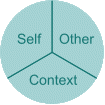
The Irrelevant Configuration
How would the emergency project situation unfold in an Irrelevant organization? Recall that the project team is deep in a schedule crisis on its current effort. We might hear questions and comments such as:
- Anybody wanna play foosball after this?
- Can we get back to the March defect report on the controller assembly suppliers?
- Has anyone heard the rumors about the reorganization? about the requirement that we use the in-house project management software?
- You know, we'd all be able to work a lot more efficiently if we had that central Design Server working. What's the latest on that?
- I'm looking at the agenda, and I don't see anything about the next major revision of the Gimlet products. I think we need to resolve the open issues soon, or we'll have to slip that ship date.
- I'm sorry I couldn't get you my latest schedule estimates for this meeting. I had to attend the Quality of Life seminar, and the last chance was yesterday afternoon. I'll have the numbers by the day after tomorrow.
- Who's our representative on the Division Picnic committee?
From Irrelevance to Congruence
In Irrelevant coping, the organization fails to take account of all three elements — Self, Other, and Context. Moving from that position to one of Congruence is perhaps more difficult than moving from any other stance to Congruence. The good news is that it doesn't matter where you start. Getting any focus on Self, Other, or Context is a step forward.
Although Irrelevance can be constructively distracting at times, especially when humor is used to defuse tension, some Irrelevance is destructively distracting. When the Irrelevance is institutionalized, deal with it at the institutional level. For example, if Quality of Life Seminar attendance is mandatory, and your project team can't spare the time right now, seek a waiver, or ask for a special event at a later date. For meetings, make certain that you have a pre-announced agenda, and demand that the group restrict its deliberations to that agenda.
Distracting comments or questions, such as the foosball and picnic examples above, are especially difficult. In meetings, it really is the facilitator's responsibility to intervene and stop any such discussion, unless these items are in place on the agenda. If you aren't the facilitator, you have some choices when irrelevant issues crop up.
- You can do nothing, and either hope that it will pass, or that someone else will intervene, or just live with the consequences of the irrelevance.
- You can intervene by action, saying something along the lines of, "I like foosball too, as many of you know, but I also like Mike's solution to the memory footprint problem, because …" This approach acknowledges the fun people were having, and then gently tries to bring the focus back to business.
- If you have a "process check" custom in your organization, you can call a process check.
- You can directly ask the facilitator to intervene, realizing, of course, that the facilitator might feel that you are infringing on his or her responsibility.
- You can let things happen, and then discuss the process with the facilitator offline.
 Top
Top
Back to "Organizational Coping Patterns"
References
- Overy 1995
 Overy, Richard. Why the Allies Won. New York: W.W.
Norton and Company, 1995. Order from Amazon.com
Overy, Richard. Why the Allies Won. New York: W.W.
Norton and Company, 1995. Order from Amazon.com- Wouk 1987
 Wouk, Herman. The Caine Mutiny: A Novel of World War
II. Annapolis: Naval Institute Press, 1987. Order from Amazon.com
Wouk, Herman. The Caine Mutiny: A Novel of World War
II. Annapolis: Naval Institute Press, 1987. Order from Amazon.com- Dmytryk 1954
 The Caine Mutiny (1954). Humphrey Bogart, José
Ferrer. Dir. Edward Dmytryk. Columbia/Tristar. Order from Amazon.com
The Caine Mutiny (1954). Humphrey Bogart, José
Ferrer. Dir. Edward Dmytryk. Columbia/Tristar. Order from Amazon.com
Are you a writer, editor or publisher on deadline? Are you looking for an article that will get people talking and get compliments flying your way? You can have 500-1000 words in your inbox in one hour. License any article from this Web site. More info
Follow Rick


Send an email message to a friend
rbrenIyeJIiAfnGdKlUXrner@ChacsxirZwZlENmHUNHioCanyon.comSend a message to Rick
A Tip A Day feed
Point Lookout weekly feed
 My blog, Technical Debt for Policymakers, offers
resources, insights, and conversations of interest to policymakers who are concerned with managing
technical debt within their organizations. Get the millstone of technical debt off the neck of your
organization!
My blog, Technical Debt for Policymakers, offers
resources, insights, and conversations of interest to policymakers who are concerned with managing
technical debt within their organizations. Get the millstone of technical debt off the neck of your
organization!Point Lookout by
starting your Amazon search here

 Bad boss, long commute, troubling ethical questions, hateful colleague? Learn what we can do when we
love the work but not the job.Are your project teams plagued by turnover, burnout, and high defect rates? Turn your culture around.Fed up with tense, explosive meetings? Are you the target of a bully? Learn how to make peace with conflict.Learn how to make meetings more productive — and more rare.
Bad boss, long commute, troubling ethical questions, hateful colleague? Learn what we can do when we
love the work but not the job.Are your project teams plagued by turnover, burnout, and high defect rates? Turn your culture around.Fed up with tense, explosive meetings? Are you the target of a bully? Learn how to make peace with conflict.Learn how to make meetings more productive — and more rare.