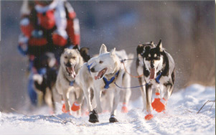
Huskies along the trail during start day, March 1998, Iditarod Trail Sled Dog Race. At distances over ten miles, the racing sled dog is the fastest animal in the world. There is a widely-held, but false, belief that sled dog teams are hierarchical, and that the lead sled dog is dominant. In racing, the need for high performance creates a need for absolute teamwork, which is incompatible with hierarchy. Position along the gang line is determined not by hierarchy but by the talents required for that position, and by matching partners. This might explain why a common problem plaguing dog drivers is of the too-many-volunteers type. In a book co-authored with Lorna Coppinger, Dogs: A Startling New Understanding of Canine Origin, Behavior and Evolution (Order from Amazon.com), Raymond Coppinger tells a story about his dog Rena that illustrates this point. One race weekend, Rena had sore feet and he had to leave her at home. She howled continuously for days, and when he returned she was so hoarse that her barks were nothing but squeaks. Rena would not be denied. Note: Although some consider the Iditarod to be cruel and abusive of the dogs, sled dog racing generally is less controversial. Photo by Jeff Schultz, courtesy the U.S. Library of Congress.
Leaders of all kinds ask for volunteers for specific, short-duration tasks. Volunteers tend to be more intrinsically motivated — they want to do well because they sought the assignment. Yet, asking for volunteers isn't always as easy as we'd hope. Here's Part I of a collection of tactics to help you through the sticky situations that sometimes arise when asking for volunteers.
- When nobody volunteers
- Very little is more demoralizing to a team leader than that awkward silence that follows a request for volunteers. People tend to assume that nobody wants the job, and filling the position in question — or other positions, too — can become more difficult.
- Perhaps the job is repugnant or stigmatized. If so, sweeten the package somehow in advance.
- But silence doesn't necessarily mean nobody wants the job. People can decline for fear of rejection, or overload, or because they anticipate more appealing opportunities.
- If you expect awkward silence, consider whether you're asking too much, or whether your past behavior might be at issue. Perhaps people see working with you as risky, or not worth the trouble.
- If your requests are reasonable, if you've treated volunteers well, and you still have trouble, then seek volunteers in other ways. Try personal contact by email, telephone, or in face-to-face.
- When too many volunteer
- When too many people volunteer, you must choose some and reject others. In a healthy team, this isn't a big deal. People know that your selection of others doesn't necessarily reflect on those not selected, and they know that other opportunities will follow.
- But if some team members might experience painful rejection, your choice to accept other offers can be problematic. This can happen to team leaders who've acquired a reputation for setting team members against one another, or who've used plum assignments as a means of creating competition. Or it can happen when leaders systematically reject the offers of some team members without explanation, or when team leaders have played favorites.
- Accepting all applicants isn't a solution, because it fails to address the basic problem: too many for the task at hand. If you expect that too many will volunteer, make your request in a way that limits this risk. Make your request offline, and apply an objective criterion such as "first to reply." Or contact individuals by telephone or in person.
The leaders' Accepting all applicants
isn't a solution, because
it fails to address the
basic problem: too many
for the task at handown motivations are also important. Some examples: we might ask for volunteers because we seek the validation that volunteers provide; or we might fear being rejected if we simply ask someone to take on added responsibility. Dealing with these issues by shifting the burden to the team isn't likely to work — people can sense the true motive. Seek volunteers because you really want volunteers.
Next time, we'll turn to questions about getting the right people and the right leadership. Next in this series  Top
Top  Next Issue
Are your projects always (or almost always) late and over budget? Are your project teams plagued by turnover, burnout, and high defect rates? Turn your culture around. Read 52 Tips for Leaders of Project-Oriented Organizations, filled with tips and techniques for organizational leaders. Order Now!
Your comments are welcome
Would you like to see your comments posted here? rbrendPtoGuFOkTSMQOzxner@ChacEgGqaylUnkmwIkkwoCanyon.comSend me your comments by email, or by Web form.About Point Lookout
 Thank you for reading this article. I hope you enjoyed it and
found it useful, and that you'll consider recommending it to a friend.
Thank you for reading this article. I hope you enjoyed it and
found it useful, and that you'll consider recommending it to a friend.
This article in its entirety was written by a human being. No machine intelligence was involved in any way.
Point Lookout is a free weekly email newsletter. Browse the archive of past issues. Subscribe for free.
Support Point Lookout by joining the Friends of Point Lookout, as an individual or as an organization.
Do you face a complex interpersonal situation? Send it in, anonymously if you like, and I'll give you my two cents.
Related articles
More articles on Personal, Team, and Organizational Effectiveness:
 When Your Boss Is a Micromanager
- If your boss is a micromanager, your life can be a seemingly endless misery of humiliation and frustration.
Changing your boss is one possible solution, but it's unlikely to succeed. What you can do
is change the way you experience the micromanagement.
 Smart Bookshelves
- If you like to browse in bookstores, you probably know the thrill of new ideas and new perspectives.
When I find a book worth reading, I want to own it, and that's how it gets to my shelf. Here are some
tips to help you read more of what you really want to read.
 High Falutin' Goofy Talk
- Business speech and business writing are sometimes little more than high falutin' goofy talk, filled
with pretentious, overused images and puff phrases of unknown meaning. Here are some phrases that are
so common that we barely notice them.
 Risk Creep: I
- Risk creep is a term that describes the insidious and unrecognized increase in risk that occurs despite
our every effort to mitigate risk or avoid it altogether. What are the dominant sources of risk creep?
 Personal Feasibility Decisions
- When considering whether to exploit a rare but desirable opportunity, there is a risk that desire can
overcome good sense. Having at hand a predefined framework for making such decisions reduces the risk
of blundering by acting in haste.
See also Personal, Team, and Organizational Effectiveness for more related articles.
Forthcoming issues of Point Lookout
 Coming May 1: Antipatterns for Time-Constrained Communication: 2
- Recognizing just a few patterns that can lead to miscommunication can reduce the incidence of miscommunications. Here's Part 2 of a collection of antipatterns that arise in communication under time pressure, emphasizing those that depend on content. Available here and by RSS on May 1.
- And on May 8: Antipatterns for Time-Constrained Communication: 3
- Recognizing just a few patterns that can lead to miscommunication can reduce the incidence of problems. Here is Part 3 of a collection of antipatterns that arise in technical communication under time pressure, emphasizing past experiences of participants. Available here and by RSS on May 8.
Coaching services
I offer email and telephone coaching at both corporate and individual rates. Contact Rick for details at rbrendPtoGuFOkTSMQOzxner@ChacEgGqaylUnkmwIkkwoCanyon.com or (650) 787-6475, or toll-free in the continental US at (866) 378-5470.
Get the ebook!
Past issues of Point Lookout are available in six ebooks:
- Get 2001-2 in Geese Don't Land on Twigs (PDF, )
- Get 2003-4 in Why Dogs Wag (PDF, )
- Get 2005-6 in Loopy Things We Do (PDF, )
- Get 2007-8 in Things We Believe That Maybe Aren't So True (PDF, )
- Get 2009-10 in The Questions Not Asked (PDF, )
- Get all of the first twelve years (2001-2012) in The Collected Issues of Point Lookout (PDF, )
Are you a writer, editor or publisher on deadline? Are you looking for an article that will get people talking and get compliments flying your way? You can have 500-1000 words in your inbox in one hour. License any article from this Web site. More info
Follow Rick


Recommend this issue to a friend
Send an email message to a friend
rbrendPtoGuFOkTSMQOzxner@ChacEgGqaylUnkmwIkkwoCanyon.comSend a message to Rick
A Tip A Day feed
Point Lookout weekly feed
 My blog, Technical Debt for Policymakers, offers
resources, insights, and conversations of interest to policymakers who are concerned with managing
technical debt within their organizations. Get the millstone of technical debt off the neck of your
organization!
My blog, Technical Debt for Policymakers, offers
resources, insights, and conversations of interest to policymakers who are concerned with managing
technical debt within their organizations. Get the millstone of technical debt off the neck of your
organization! Bad boss, long commute, troubling ethical questions, hateful colleague? Learn what we can do when we
love the work but not the job.Learn how to make your virtual global team sing.Are you managing a change effort that faces rampant cynicism, passive non-cooperation, or
maybe even outright revolt?Learn how to make meetings more productive — and more rare.
Bad boss, long commute, troubling ethical questions, hateful colleague? Learn what we can do when we
love the work but not the job.Learn how to make your virtual global team sing.Are you managing a change effort that faces rampant cynicism, passive non-cooperation, or
maybe even outright revolt?Learn how to make meetings more productive — and more rare.