Most of us believe that we make organizational decisions on the basis of organizational priorities alone. But it just ain't so — sometimes we take into account personal consequences, using organizational influence to limit negative consequences for our own careers, status, and compensation.
Often this behavior is quite ethical. It's encouraged — even embedded into compensation structures. Our stock option plans and profit-sharing plans exploit the pressure of personal consequences by aligning personal and organizational interests. At least, that's the theory.
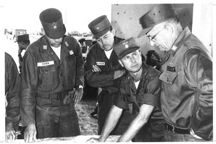
Lt. Col. John Paul Vann (second from right) briefs his colleagues in Vietnam. Col. Vann was an advocate of a strategy similar to what we now attribute to U.S. Gen. Petraeus in Iraq — enhanced dependence on small units, dispersed amongst the population, coupled with increasing reliance on forces drawn from that population. Col. Vann, who spent most of his years in Vietnam as a civilian, was known for his forthright assessments of the reality of the U.S. position, which he offered with relatively little regard for "personal risk management." As described by Neil Sheehan in his Pulitzer Prize winning history, A Bright Shining Lie: John Paul Vann and America in Vietnam (Order from Amazon.com), Col. Vann was asked at a 1967 meeting with Walt Rostow whether the United States would be over the worst of the war in six months. "Oh, hell no, Mr. Rostow," he said. "I'm a born optimist. I think we can hold out longer than that." Col. Vann was awarded the Presidential Medal of Freedom in 1972. Photo courtesy U.S. Library of Congress.
But sometimes decision makers use their influence to achieve effects that confirm their own personal self worth in less benign ways — sometimes for personal economic gain, as in the case of stock options and profit sharing, and sometimes for other reasons. Those other motives include personal risk management.
Personal risk management is the practice of using organizational influence to protect one's career, personal status or personal compensation. This behavior can occur even when organizational consequences are clearly negative. Here are three typical illustrations.
- Aggressive project schedules and budgets
- Project sponsors who advocate very tight project schedules and budgets might be doing so for personal advantage, when gaining commitments to those goals might reflect well on them. The failure to meet those goals might reflect badly also, but if the sponsor intends to be long-gone by then, that risk is mitigated.
- To limit this behavior, limit project goals and shorten project schedules. Short schedules enhance the likelihood that aggressive sponsors will suffer the consequences of aggressive goals.
- Padded estimates
- Project managers sometimes "pad" cost or schedule estimates to protect against the personal performance penalties associated with budget or schedule overruns. Much padding behavior is anticipatory — it provides protection from sponsors who are overly aggressive about budget and schedule, and against externally imposed requirements volatility. But some padding is just "insurance."
- To limit Unrealistic project schedules
and pathologically tight
budgets are sometimes
little more than career
advancement tacticsthis behavior, monitor budget and schedule underruns. Investigate patterns to determine whether padding is being used for insurance. - Unrealistic promises to customers and investors
- Account executives or enterprise executives who promise customers or investors aggressive performance might please the promise recipients, but the organizational cost can be unbearable. This behavior is most common at the ends of quota or fiscal periods, or near commission thresholds, or during time-limited "incentive" periods. It's all a consequence of using extrinsic rewards to enhance personal performance.
- To limit this risk, avoid extrinsic rewards, or failing that, include in the calculation of personal incentives a negative effect for promises to customers or investors that are unsupported by prior organizational commitments, whether or not they're achievable or achieved.
Although most personal risk management strategies conflict with organizational goals, asking people to just stop doing it is usually futile, because they're caught in a system that demands it. To bring an end to personal risk management, we must change the systems that cause it.  Top
Top  Next Issue
Are your projects always (or almost always) late and over budget? Are your project teams plagued by turnover, burnout, and high defect rates? Turn your culture around. Read 52 Tips for Leaders of Project-Oriented Organizations, filled with tips and techniques for organizational leaders. Order Now!
Your comments are welcome
Would you like to see your comments posted here? rbrendPtoGuFOkTSMQOzxner@ChacEgGqaylUnkmwIkkwoCanyon.comSend me your comments by email, or by Web form.About Point Lookout
 Thank you for reading this article. I hope you enjoyed it and
found it useful, and that you'll consider recommending it to a friend.
Thank you for reading this article. I hope you enjoyed it and
found it useful, and that you'll consider recommending it to a friend.
This article in its entirety was written by a human being. No machine intelligence was involved in any way.
Point Lookout is a free weekly email newsletter. Browse the archive of past issues. Subscribe for free.
Support Point Lookout by joining the Friends of Point Lookout, as an individual or as an organization.
Do you face a complex interpersonal situation? Send it in, anonymously if you like, and I'll give you my two cents.
Related articles
More articles on Ethics at Work:
 You Have to Promise Not to Tell a Soul
- You're at lunch with one of your buddies, who's obviously upset. You ask why. "You have to promise
not to tell a soul," is the response. You promise. And there the trouble begins.
 Budget Shenanigans: Swaps
- When projects run over budget, managers face a temptation to use creative accounting to address the
problem. The budget swap is one technique for making ends meet. It distorts organizational data, and
it's just plain unethical.
 Email Ethics
- Ethics is the system of right and wrong that forms the foundation of civil society. Yet, when a new
technology arrives, explicitly extending the ethical code seems necessary — no matter how civil
the society. And so it is with email.
 Virtual Termination with Real Respect
- When we have to terminate someone who works at a remote site, sometimes there's a temptation to avoid
travel — to use email, phone, fax, or something else. They're all bad ideas. Terminating people
in person is not only a gesture of respect. It's good business.
 Vendor Mismanagement
- When we outsource knowledge work to vendors, we expect to achieve the desired result with less risk
and uncertainty than if we did the work ourselves. But mission creep, mission retrenchment and employee
capture can lead to less welcome results.
See also Ethics at Work and Managing Your Boss for more related articles.
Forthcoming issues of Point Lookout
 Coming May 1: Antipatterns for Time-Constrained Communication: 2
- Recognizing just a few patterns that can lead to miscommunication can reduce the incidence of miscommunications. Here's Part 2 of a collection of antipatterns that arise in communication under time pressure, emphasizing those that depend on content. Available here and by RSS on May 1.
- And on May 8: Antipatterns for Time-Constrained Communication: 3
- Recognizing just a few patterns that can lead to miscommunication can reduce the incidence of problems. Here is Part 3 of a collection of antipatterns that arise in technical communication under time pressure, emphasizing past experiences of participants. Available here and by RSS on May 8.
Coaching services
I offer email and telephone coaching at both corporate and individual rates. Contact Rick for details at rbrendPtoGuFOkTSMQOzxner@ChacEgGqaylUnkmwIkkwoCanyon.com or (650) 787-6475, or toll-free in the continental US at (866) 378-5470.
Get the ebook!
Past issues of Point Lookout are available in six ebooks:
- Get 2001-2 in Geese Don't Land on Twigs (PDF, )
- Get 2003-4 in Why Dogs Wag (PDF, )
- Get 2005-6 in Loopy Things We Do (PDF, )
- Get 2007-8 in Things We Believe That Maybe Aren't So True (PDF, )
- Get 2009-10 in The Questions Not Asked (PDF, )
- Get all of the first twelve years (2001-2012) in The Collected Issues of Point Lookout (PDF, )
Are you a writer, editor or publisher on deadline? Are you looking for an article that will get people talking and get compliments flying your way? You can have 500-1000 words in your inbox in one hour. License any article from this Web site. More info
Follow Rick


Recommend this issue to a friend
Send an email message to a friend
rbrendPtoGuFOkTSMQOzxner@ChacEgGqaylUnkmwIkkwoCanyon.comSend a message to Rick
A Tip A Day feed
Point Lookout weekly feed
 My blog, Technical Debt for Policymakers, offers
resources, insights, and conversations of interest to policymakers who are concerned with managing
technical debt within their organizations. Get the millstone of technical debt off the neck of your
organization!
My blog, Technical Debt for Policymakers, offers
resources, insights, and conversations of interest to policymakers who are concerned with managing
technical debt within their organizations. Get the millstone of technical debt off the neck of your
organization! Bad boss, long commute, troubling ethical questions, hateful colleague? Learn what we can do when we
love the work but not the job.Learn how to make your virtual global team sing.Are you managing a change effort that faces rampant cynicism, passive non-cooperation, or
maybe even outright revolt?Learn how to make meetings more productive — and more rare.
Bad boss, long commute, troubling ethical questions, hateful colleague? Learn what we can do when we
love the work but not the job.Learn how to make your virtual global team sing.Are you managing a change effort that faces rampant cynicism, passive non-cooperation, or
maybe even outright revolt?Learn how to make meetings more productive — and more rare.