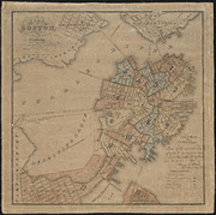
Boston in 1826. Compare this map to Boston today to appreciate how much of the city's land is actually claimed from the sea and estuaries. (A large, zoomable version of the 1826 map is available at the Web site of the Norman B. Leventhal Map Center at the Boston Public Library. A large version of modern Boston is available at the National Park Service Web site.)

Claiming land to make more space for a city is analogous to clearing your inbox to make more space for new mail. Once the clutter is removed and your day-to-day operations are more regular, you'll be more effective. Messages will be easier to find, things won't get lost in your inbox, and you'll feel better about the whole thing. Like creating new land for a city, clearing your inbox creates value from empty space.
If your email inbox is bloated, you probably want to clean it up. If you cleared it out recently, and it's gradually re-bloating, you probably fear it's happening again. Maybe you've just given up altogether.
Unless you have an assistant, or you're one of the carefully energetic few who regularly keep their inboxes clear, bloat and bloat anxiety are facts of life. Advice about how to keep your inbox clear once it's clear does help, but it doesn't help you get your inbox clear — it doesn't help you recover from bloat. Here are some suggestions for bloat recovery.
- Recognize that inbox bloat is a fact of your life
- Some believe that once they clear their inboxes, they'll magically stay clear. Sadly, that doesn't work. Unless you change how you operate, re-bloat is inevitable, and cleaning up is hardly worth it.
- Keep doing what you're doing
- Whatever you've been doing, keep it up for now. Beating yourself up for not dealing with every single one of today's messages is demoralizing. Instead, focus on the total message count — drive it down a little every day.
- Use sort-by-subject and sort-by-sender
- When you work on the backlog, sort your inbox by sender or subject, instead of by date. That way, related messages often appear next to each other, and you can select and deal with several at once.
- Read your new email less frequently
- Do what you can to read new email less often. Allocate some of the time you save to sorting, classifying, and deleting old mail.
- Move aged messages elsewhere
- Move all messages more than three years old to a folder elsewhere. Think about it — three years is enough time to create a toddler who sasses you back. Messages that old are unlikely to be of value, but if you want them, move them elsewhere.
- Beating yourself up for
not dealing with every
single one of today's
messages is demoralizing.
Let it go. - Filter out the junk
- Even if you're protected from junk, occasionally junk does get through. Search for the usual keywords and delete the junk. Also look for old out-of-the-office messages.
- Eat elephants in small bites
- It probably took a long time to build all the bloat in your inbox. Give yourself time to get rid of it. A goal of reducing it by 25 to 50 messages per day is reasonable, but go easy at first. Set the goal low enough to give you some experience of achievement, and before you know it, your inbox will be nearly clear.
Managing your inbox to prevent bloat requires adding some regular practices to your routine. Until you dramatically reduce the current bloat, these practices will have little effect. But you can get started learning about them, and start using each new practice as soon as you understand it. More about these in a future article.  Top
Top  Next Issue
Are you so buried in email that you don't even have time to delete your spam? Do you miss important messages? So many of the problems we have with email are actually within our power to solve, if we just realize the consequences of our own actions. Read 101 Tips for Writing and Managing Email to learn how to make peace with your inbox. Order Now!
And if you have organizational responsibility, you can help transform the culture to make more effective use of email. You can reduce volume while you make content more valuable. You can discourage email flame wars and that blizzard of useless if well-intended messages from colleagues and subordinates. Read Where There's Smoke There's Email to learn how to make email more productive at the organizational scale — and less dangerous. Order Now!
Your comments are welcome
Would you like to see your comments posted here? rbrendPtoGuFOkTSMQOzxner@ChacEgGqaylUnkmwIkkwoCanyon.comSend me your comments by email, or by Web form.About Point Lookout
 Thank you for reading this article. I hope you enjoyed it and
found it useful, and that you'll consider recommending it to a friend.
Thank you for reading this article. I hope you enjoyed it and
found it useful, and that you'll consider recommending it to a friend.
This article in its entirety was written by a human being. No machine intelligence was involved in any way.
Point Lookout is a free weekly email newsletter. Browse the archive of past issues. Subscribe for free.
Support Point Lookout by joining the Friends of Point Lookout, as an individual or as an organization.
Do you face a complex interpersonal situation? Send it in, anonymously if you like, and I'll give you my two cents.
Related articles
More articles on Effective Communication at Work:
 Begging the Question
- Begging the question is a common, usually undetected, rhetorical fallacy. It leads to unsupported conclusions
and painful places we just can't live with. What can we do when it happens?
 If Only I Had Known: II
- Ever had one of those forehead-slapping moments when someone explained something, or you suddenly realized
something? They usually involve some idea or insight that would have saved you much pain, trouble, and
heartache, if only you had known.
 Dismissive Gestures: II
- In the modern organization, since direct verbal insults are considered "over the line," we've
developed a variety of alternatives, including a class I call "dismissive gestures." They
hurt personally, and they harm the effectiveness of the organization. Here's Part II of a little catalog
of dismissive gestures.
 Masked Messages
- Sometimes what we say to each other isn't what we really mean. We mask the messages, or we form them
into what are usually positive structures, to make them appear to be something less malicious than they
are. Here are some examples of masked messages.
 The Ups and Downs of American Handshakes: II
- Where the handshake is a customary business greeting, it's possible to offend accidentally. Here's Part
II of a set of guidelines for handshakes in the USA.
See also Effective Communication at Work, Writing and Managing Email and Virtual and Global Teams for more related articles.
Forthcoming issues of Point Lookout
 Coming May 15: Should I Write or Should I Call?
- After we recognize the need to contact a colleague or colleagues to work out a way to move forward, we next must decide how to make contact. Phone? Videoconference? Text message? There are some simple criteria that can help with such decisions. Available here and by RSS on May 15.
 And on May 22: Rescheduling Collaborative Work
- Rescheduling is what we do when the schedule we have now is so desperately unachievable that we must let go of it because when we look at it we can no longer decide whether to laugh or cry. The fear is that the new schedule might come to the same end. Available here and by RSS on May 22.
Coaching services
I offer email and telephone coaching at both corporate and individual rates. Contact Rick for details at rbrendPtoGuFOkTSMQOzxner@ChacEgGqaylUnkmwIkkwoCanyon.com or (650) 787-6475, or toll-free in the continental US at (866) 378-5470.
Get the ebook!
Past issues of Point Lookout are available in six ebooks:
- Get 2001-2 in Geese Don't Land on Twigs (PDF, )
- Get 2003-4 in Why Dogs Wag (PDF, )
- Get 2005-6 in Loopy Things We Do (PDF, )
- Get 2007-8 in Things We Believe That Maybe Aren't So True (PDF, )
- Get 2009-10 in The Questions Not Asked (PDF, )
- Get all of the first twelve years (2001-2012) in The Collected Issues of Point Lookout (PDF, )
Are you a writer, editor or publisher on deadline? Are you looking for an article that will get people talking and get compliments flying your way? You can have 500-1000 words in your inbox in one hour. License any article from this Web site. More info
Follow Rick


Recommend this issue to a friend
Send an email message to a friend
rbrendPtoGuFOkTSMQOzxner@ChacEgGqaylUnkmwIkkwoCanyon.comSend a message to Rick
A Tip A Day feed
Point Lookout weekly feed
 My blog, Technical Debt for Policymakers, offers
resources, insights, and conversations of interest to policymakers who are concerned with managing
technical debt within their organizations. Get the millstone of technical debt off the neck of your
organization!
My blog, Technical Debt for Policymakers, offers
resources, insights, and conversations of interest to policymakers who are concerned with managing
technical debt within their organizations. Get the millstone of technical debt off the neck of your
organization! Bad boss, long commute, troubling ethical questions, hateful colleague? Learn what we can do when we
love the work but not the job.Learn how to make your virtual global team sing.Are you managing a change effort that faces rampant cynicism, passive non-cooperation, or
maybe even outright revolt?Learn how to make meetings more productive — and more rare.
Bad boss, long commute, troubling ethical questions, hateful colleague? Learn what we can do when we
love the work but not the job.Learn how to make your virtual global team sing.Are you managing a change effort that faces rampant cynicism, passive non-cooperation, or
maybe even outright revolt?Learn how to make meetings more productive — and more rare.