If you've ever run into roadblocks as you tried to get your work done, and if those roadblocks were due to delays and decisions by co-workers, you might have felt that some people were actually trying to block your efforts. Although intentional obstruction is probably rarer than it seems, the ability to recognize it when it does occur is nevertheless helpful.
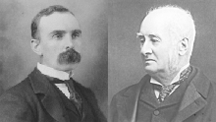
Professor John Walker Gregory, D.Sc., FRS (left), and Sir Clements Markham, KCB, FRS. As head of the Royal Geographic Society, Markham led the creation of the British Antarctic Expedition (1901-1904). Encountering some difficulty in obtaining funds, he enlisted the aid of the Royal Society. Markham had envisioned an expedition led by officers of the Royal Navy, including the already-designated leader Commander Robert F. Scott. Scott had little command experience, and no polar experience. The Royal Society preferred scientific leadership, and was able to insert Professor Gregory, who was then a respected explorer and geologist, and who had been part of a team that had crossed Spitzbergen. Gregory formulated a sound plan that, in retrospect, was similar to that of Roald Amundsen, who later led the first expedition to reach the South Pole.
Markham, however, had a different agenda. He was interested in science, but more interested in having the Royal Navy lead the expedition. To make Scott the sole leader of the expedition, and to then place control of the expedition in the hands of naval officers, Markham successfully pressured Gregory to resign. The expedition was then firmly in the control of Markham and officers of the Royal Navy. Markham's tactics were a form of mis-promotion. By replacing Gregory with Scott, he gained much more control (in fact, nearly complete control) of the agenda of the expedition. The move, in effect, obstructed the influence of the Royal Society on the expedition. For more about the first British Antarctic Expedition, see Roland Huntford's The Last Place on Earth. Order from Amazon.com.
Here's Part II of a little catalog of obstructionist tactics. See "Obstructionist Tactics: I," Point Lookout for July 23, 2008, for Part I.
- Misrepresenting to regulators
- If the output or processes of the team are subject to regulation, internal or external, the obstructor can convey misinformation to the regulators. The information conveyed might contain a germ of truth, but it's usually packaged in a manner that creates or stimulates the urge to investigate. The investigation is then a source of delay and distraction to the team.
- Agitating stakeholders
- Obstructors who have contact with external stakeholders, such as customers, might elect to motivate them by disclosing information the obstructors consider to be influential relative to their own aims. The external stakeholders then attempt to accelerate the action of the group in the stakeholders' preferred direction, which, by the design of the obstructor, interferes with the group's progress.
- Mis-promoting
- A technique available to managers involves promoting someone into a position for which he or she might or might not be qualified, so as to gain political advantage for the manager. When this is done, there is an agreement in advance between the obstructing manager and the person promoted. That agreement makes clear between them that the manager's agenda is primary, and that the person promoted will take actions to promote that agenda, deniably, in a manner always consistent with organizational policy. That agenda can include obstruction.
- Career trashing
- Most visible, inspiring objectives have champions — people who have successfully communicated the inspiring objective throughout the organization. To delay, or even halt, movement toward those objectives, obstructors sometimes attack the person of the champion. By trashing the career of the champion, obstructors deprive the target task of its voice, sometimes fatally weakening the organizational will to continue.
- Disrupting
- Any complex group effort entails making a series of decisions, and then building on the foundation they comprise. Obstructors can disrupt progress by raising questions about previously settled decisions. The parts of the foundation with greatest leverage are those that underlie large numbers of subsequent choices. These decisions are the favored targets of obstructors who use this tactic.
- Misrepresenting the environment
- Obstructors can disrupt
progress by raising questions
about previously
settled decisions - Both organizations and projects require accurate, effective situational awareness. They must understand the competitive environment, their suppliers, and their customers. By propagating misinformation about the competitive or intellectual environment, or by delaying the transfer of accurate information, obstructors can confuse, mislead, or stimulate debate about objectives, tasks, or persons (especially rivals). The resulting discussions are at least distracting, and could lead to delays and bad decisions.
Now that we've surveyed the tactics, we'll be taking a closer look at them — and how to respond to them — in future issues. First in this series  Top
Top  Next Issue
Is every other day a tense, anxious, angry misery as you watch people around you, who couldn't even think their way through a game of Jacks, win at workplace politics and steal the credit and glory for just about everyone's best work including yours? Read 303 Secrets of Workplace Politics, filled with tips and techniques for succeeding in workplace politics. More info
Your comments are welcome
Would you like to see your comments posted here? rbrendPtoGuFOkTSMQOzxner@ChacEgGqaylUnkmwIkkwoCanyon.comSend me your comments by email, or by Web form.About Point Lookout
 Thank you for reading this article. I hope you enjoyed it and
found it useful, and that you'll consider recommending it to a friend.
Thank you for reading this article. I hope you enjoyed it and
found it useful, and that you'll consider recommending it to a friend.
This article in its entirety was written by a human being. No machine intelligence was involved in any way.
Point Lookout is a free weekly email newsletter. Browse the archive of past issues. Subscribe for free.
Support Point Lookout by joining the Friends of Point Lookout, as an individual or as an organization.
Do you face a complex interpersonal situation? Send it in, anonymously if you like, and I'll give you my two cents.
Related articles
More articles on Workplace Politics:
 Workplace Politics Is Not a Game
- We often think about "playing the game" — either with relish or repugnance. Whatever
your level of skill or interest, you'll do better if you see workplace politics as it is. It is not a game.
 On Organizational Coups d'Etat
- If your boss is truly incompetent, or maybe even evil, organizing a coup d'etat might have
crossed your mind. In most cases, it's wise to let it cross on through, all the way. Think of alternative
ways out.
 Group Problem-Solving Tangles
- When teams solve problems together, discussions of proposed solutions usually focus on combinations
of what the solution will do, how much it will cost, how long it will take, and much more. Disentangling
these threads can make discussions much more effective.
 Suppressing Dissent: I
- In some groups, disagreeing with the majority, or disagreeing with the Leader, can be a personally expensive
act. Here is Part I of a set of tactics used by Leaders who choose not to tolerate dissent.
 Bad Trouble: Misdirection
- When Bad Trouble develops at work we have a chance to see what our organizational cultures are made
of. Many of our colleagues respond constructively. When they don't, misdirection tactics are popular.
Here's a little catalog of misdirection responses.
See also Workplace Politics and Conflict Management for more related articles.
Forthcoming issues of Point Lookout
 Coming May 1: Antipatterns for Time-Constrained Communication: 2
- Recognizing just a few patterns that can lead to miscommunication can reduce the incidence of miscommunications. Here's Part 2 of a collection of antipatterns that arise in communication under time pressure, emphasizing those that depend on content. Available here and by RSS on May 1.
- And on May 8: Antipatterns for Time-Constrained Communication: 3
- Recognizing just a few patterns that can lead to miscommunication can reduce the incidence of problems. Here is Part 3 of a collection of antipatterns that arise in technical communication under time pressure, emphasizing past experiences of participants. Available here and by RSS on May 8.
Coaching services
I offer email and telephone coaching at both corporate and individual rates. Contact Rick for details at rbrendPtoGuFOkTSMQOzxner@ChacEgGqaylUnkmwIkkwoCanyon.com or (650) 787-6475, or toll-free in the continental US at (866) 378-5470.
Get the ebook!
Past issues of Point Lookout are available in six ebooks:
- Get 2001-2 in Geese Don't Land on Twigs (PDF, )
- Get 2003-4 in Why Dogs Wag (PDF, )
- Get 2005-6 in Loopy Things We Do (PDF, )
- Get 2007-8 in Things We Believe That Maybe Aren't So True (PDF, )
- Get 2009-10 in The Questions Not Asked (PDF, )
- Get all of the first twelve years (2001-2012) in The Collected Issues of Point Lookout (PDF, )
Are you a writer, editor or publisher on deadline? Are you looking for an article that will get people talking and get compliments flying your way? You can have 500-1000 words in your inbox in one hour. License any article from this Web site. More info
Follow Rick


Recommend this issue to a friend
Send an email message to a friend
rbrendPtoGuFOkTSMQOzxner@ChacEgGqaylUnkmwIkkwoCanyon.comSend a message to Rick
A Tip A Day feed
Point Lookout weekly feed
 The message of Point Lookout is unique. Help get the message out. Please donate to help keep Point Lookout available for free to everyone.
 My blog, Technical Debt for Policymakers, offers
resources, insights, and conversations of interest to policymakers who are concerned with managing
technical debt within their organizations. Get the millstone of technical debt off the neck of your
organization!
My blog, Technical Debt for Policymakers, offers
resources, insights, and conversations of interest to policymakers who are concerned with managing
technical debt within their organizations. Get the millstone of technical debt off the neck of your
organization!Beware any resource that speaks of "winning" at workplace politics or "defeating" it. You can benefit or not, but there is no score-keeping, and it isn't a game.
- Wikipedia has a nice article with a list of additional resources
- Some public libraries offer collections. Here's an example from Saskatoon.
- Check my own links collection
- LinkedIn's Office Politics discussion group
 Is every other day a tense, anxious, angry misery as you watch people around you, who couldn't even
think their way through a game of Jacks, win at workplace politics and steal the credit and glory
for just about everyone's best work including yours? Read 303 Secrets of Workplace Politics!Learn how to make your virtual global team sing.A Tip a Day arrives by email, or by RSS Feed, each business day. It's 20 to 30 words at most, and gives
you a new perspective on the hassles and rewards of work life. Most tips also contain links to
related articles. Free!Learn how to make meetings more productive — and more rare.
Is every other day a tense, anxious, angry misery as you watch people around you, who couldn't even
think their way through a game of Jacks, win at workplace politics and steal the credit and glory
for just about everyone's best work including yours? Read 303 Secrets of Workplace Politics!Learn how to make your virtual global team sing.A Tip a Day arrives by email, or by RSS Feed, each business day. It's 20 to 30 words at most, and gives
you a new perspective on the hassles and rewards of work life. Most tips also contain links to
related articles. Free!Learn how to make meetings more productive — and more rare.